


| {"year": "2009", "tier": "T2", "problem_label": "1", "problem_type": null, "exam": "Canada_MO", "problem": "Given an $m \\times n$ grid with squares coloured either black or white, we say that a black square in the grid is stranded if there is some square to its left in the same row that is white and there is some square above it in the same column that is white (see Figure).\n\n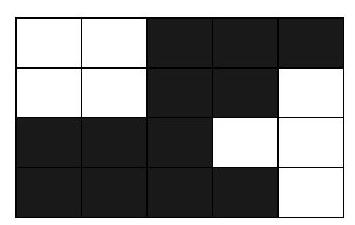\n\nFiguRE 1. A $4 \\times 5$ grid with no stranded black squares\n\nFind a closed formula for the number of $2 \\times n$ grids with no stranded black squares.", "solution": "There is no condition for squares in the first row. A square in the second row can be black only if the square above it is black or all squares to the left of it are black. Suppose the first $k$ squares in the second row are black and the $(k+1)$-st square is white or $k=n$. When $k<n$ then for each of the first $k+1$ squares in the first row we have 2 choices, and for each of the remaining $n-k-1$ columns we have 3 choices. When $k=n$, there are $2^{n}$ choices for the first row. The total number of choices is thus:\n\n$$\n\\sum_{k=0}^{n-1} 2^{k+1} 3^{n-k-1}+2^{n}\n$$\n\nThis expression simplifies to\n\n$$\n2 \\cdot 3^{n}-2^{n}\n$$\n\n## CANADIAN MATHEMATICAL OLYMPIAD 2009 SOLUTIONS", "metadata": {"resource_path": "Canada_MO/segmented/en-sol2009.jsonl", "problem_match": "\nProblem 1.", "solution_match": "\nSolution."}} | |
| {"year": "2009", "tier": "T2", "problem_label": "2", "problem_type": null, "exam": "Canada_MO", "problem": "Two circles of different radii are cut out of cardboard. Each circle is subdivided into 200 equal sectors. On each circle 100 sectors are painted white and the other 100 are painted black. The smaller circle is then placed on top of the larger circle, so that their centers coincide. Show that one can rotate the small circle so that the sectors on the two circles line up and at least 100 sectors on the small circle lie over sectors of the same color on the big circle.", "solution": "Let $x_{0}, \\ldots, x_{199}$ be variables. Assign the value of +1 or -1 to $x_{i}$ depending on whether the $(i+1)$ st segment of the larger circle (counting counterclockwise) is black or white, respectively. Similarly, assign the value of +1 or -1 to the variable $y_{i}$ depending on whether the $(i+1)$ th segment of the smaller circle is black or white. We can now restate the problem in the following equivalent way: show that\n\n$$\nS_{j}=\\sum_{i=1}^{200} x_{i} y_{i+j} \\geq 0\n$$\n\nfor some $j=0, \\ldots, 199$. Here the subscript $i+j$ is understood modulo 200 .\n\nNow observe that $y_{0}+\\cdots+y_{199}=0$ and thus\n\n$$\nS_{0}+\\cdots+S_{199}=\\sum_{I=0}^{199} x_{i}\\left(y_{0}+\\cdots+y_{199}\\right)=0 .\n$$\n\nThus $S_{j} \\geq 0$ for some $j=0, \\ldots, 199$, as claimed.", "metadata": {"resource_path": "Canada_MO/segmented/en-sol2009.jsonl", "problem_match": "\nProblem 2.", "solution_match": "\nSolution."}} | |
| {"year": "2009", "tier": "T2", "problem_label": "3", "problem_type": null, "exam": "Canada_MO", "problem": "Define\n\n$$\nf(x, y, z)=\\frac{(x y+y z+z x)(x+y+z)}{(x+y)(x+z)(y+z)} .\n$$\n\nDetermine the set of real numbers $r$ for which there exists a triplet $(x, y, z)$ of positive real numbers satisfying $f(x, y, z)=r$.", "solution": "We prove that $1<f(x, y, z) \\leq \\frac{9}{8}$, and that $f(x, y, z)$ can take on any value within the range $\\left(1, \\frac{9}{8}\\right]$.\n\nThe expression for $f(x, y, z)$ can be simplified to\n\n$$\nf(x, y, z)=1+\\frac{x y z}{(x+y)(x+z)(y+z)} .\n$$\n\nSince $x, y, z$ are positive, we get $1<f(x, y, z)$.\n\nThe inequality $f(x, y, z) \\leq \\frac{9}{8}$ can be simplified to\n\n$$\nx^{2} y+x^{2} z+y^{2} x+y^{2} z+z^{2} x+z^{2} y-6 x y z \\geq 0 .\n$$\n\nRearrange the left hand side as follows:\n\n$$\n\\begin{aligned}\n& x^{2} y+x^{2} z+y^{2} x+y^{2} z+z^{2} x+z^{2} y-6 x y z= \\\\\n& x\\left(y^{2}+z^{2}\\right)-2 x y z+y\\left(x^{2}+z^{2}\\right)-2 x y z+z\\left(x^{2}+y^{2}\\right)-2 x y z= \\\\\n& x(y-z)^{2}+y(x-z)^{2}+z(x-y)^{2} .\n\\end{aligned}\n$$\n\nThis expression is clearly non-negative when $x, y, z$ are non-negative. To prove that $f(x, y, z)$ takes any values in the interval $\\left(1, \\frac{9}{8}\\right]$, define\n\n$$\ng(t)=f(t, 1,1)=1+\\frac{t}{2(1+t)^{2}}\n$$\n\nThen $g(1)=\\frac{9}{8}$ and $g(t)$ approaches 1 as $t$ approaches 0 . It follows from the continuity of $g(t)$ for $0<t \\leq 1$ that it takes all values in the interval $\\left(1, \\frac{9}{8}\\right]$. (Alternatively, one can check that the quadratic equation $g(t)=r$ has a solution $t$ for any number $r$ in the interval $\\left(1, \\frac{9}{8}\\right]$.)", "metadata": {"resource_path": "Canada_MO/segmented/en-sol2009.jsonl", "problem_match": "\nPRoblem 3.", "solution_match": "\nSolution."}} | |
| {"year": "2009", "tier": "T2", "problem_label": "4", "problem_type": null, "exam": "Canada_MO", "problem": "Find all ordered pairs $(a, b)$ such that $a$ and $b$ are integers and $3^{a}+7^{b}$ is a perfect square.", "solution": "It is obvious that $a$ and $b$ must be non-negative.\n\nSuppose that $3^{a}+7^{b}=n^{2}$. We can assume that $n$ is positive. We first work modulo 4 . Since $3^{a}+7^{b}=n^{2}$, it follows that\n\n$$\nn^{2} \\equiv(-1)^{a}+(-1)^{b} \\quad(\\bmod 4)\n$$\n\nSince no square can be congruent to 2 modulo 4 , it follows that we have either (i) $a$ is odd and $b$ is even or (ii) $a$ is even and $b$ is odd.\n\nCase (i): Let $b=2 c$. Then\n\n$$\n3^{a}=\\left(n-7^{c}\\right)\\left(n+7^{c}\\right) .\n$$\n\nIt cannot be the case that 3 divides both $n-7^{c}$ and $n+7^{c}$. But each of these is a power of 3. It follows that $n-7^{c}=1$, and therefore\n\n$$\n3^{a}=2 \\cdot 7^{c}+1 .\n$$\n\nIf $c=0$, then $a=1$, and we obtain the solution $a=1, b=0$. So suppose that $c \\geq 1$. Then $3^{a} \\equiv 1(\\bmod 7)$. This is impossible, since the smallest positive value of $a$ such that $3^{a} \\equiv 1(\\bmod 7)$ is given by $a=6$, and therefore all $a$ such that $3^{a} \\equiv 1(\\bmod 7)$ are even, contradicting the fact that $a$ is odd.\n\nCase (ii): Let $a=2 c$. Then\n\n$$\n7^{b}=\\left(n-3^{c}\\right)\\left(n+3^{c}\\right) .\n$$\n\nThus each of $n-3^{c}$ and $n+3^{c}$ is a power of 7 . Since 7 cannot divide both of these, it follows that $n-3^{c}=1$, and therefore\n\n$$\n7^{b}=2 \\cdot 3^{c}+1\n$$\n\nLook first at the case $c=1$. Then $b=1$, and we obtain the solution $a=2, b=1$. So from now on we may assume that $c>1$. Then $7^{b} \\equiv 1(\\bmod 9)$. The smallest positive integer $b$ such that $7^{b} \\equiv 1(\\bmod 9)$ is given by $b=3$. It follows that $b$ must be a multiple of 3 . Let $b=3 d$. Note that $d$ is odd, so in particular $d \\geq 1$.\n\nLet $y=7^{d}$. Then $y^{3}-1=2 \\cdot 3^{c}$, and therefore\n\n$$\n2 \\cdot 3^{c}=(y-1)\\left(y^{2}+y+1\\right) \\text {. }\n$$\n\nIt follows that $y-1=2 \\cdot 3^{u}$ for some positive $u$, and that $y^{2}+y+1=3^{v}$ for some $v \\geq 2$. But since\n\n$$\n3 y=\\left(y^{2}+y+1\\right)-(y-1)^{2},\n$$\n\nit follows that $3 \\mid y$, which is impossible since $3 \\mid(y-1)$.", "metadata": {"resource_path": "Canada_MO/segmented/en-sol2009.jsonl", "problem_match": "\nProblem 4.", "solution_match": "\nSolution."}} | |
| {"year": "2009", "tier": "T2", "problem_label": "5", "problem_type": null, "exam": "Canada_MO", "problem": "A set of points is marked on the plane, with the property that any three marked points can be covered with a disk of radius 1. Prove that the set of all marked points can be covered with a disk of radius 1 .", "solution": "(For a finite set of points only.) Let $D$ be a disk of smallest radius that covers all marked points. Consider the marked points on the boundary $C$ of this disk. Note that if all marked points on $C$ lie on an arc smaller than the half circle (ASTTHC for short), then the disk can be moved a little towards these points on the boundary and its radius can be decreased. Since we assumed that our disk has minimal radius, the marked points on its boundary do not lie on an ASTTHC.\n\nIf the two endpoints of a diagonal of $D$ are marked, then $D$ is the smallest disk containing these two points, hence must have radius at most 1 .\n\nIf there are 3 marked points on $C$ that do not lie on an ASTTHC, then $D$ is the smallest disk covering these 3 points and hence must have radius at most 1 . (In this case the triangle formed by the three points is acute and $C$ is its circumcircle.)\n\nIf there are more than 3 marked points on the boundary that do not lie on an ASTTHC, then we can remove one of them so that the remaining points again do not lie on an ASTTHC. By induction this leads us to the case of 3 points. Indeed, given 4 or more points on $C$, choose 3 points that lie on a half circle. Then the middle point can be removed.", "metadata": {"resource_path": "Canada_MO/segmented/en-sol2009.jsonl", "problem_match": "\nProblem 5.", "solution_match": "\nSolution."}} | |