---
license: mit
language:
- ar
- en
tags:
- speech
- asr
- automatic-speech-recognition
- ctc
- conformer
- egyptian-arabic
- code-switching
- arabic
- audio
- pytorch
- kenlm
- language-model
- streaming
library_name: metro-asr
pipeline_tag: automatic-speech-recognition
datasets:
- AlaaSamir/custom-egy-tts
- OmarAhmedSobhy/egyption-with-emotion-dataset
- MightyStudent/Egyptian-ASR-MGB-3
- MAdel121/arabic-egy-cleaned
- MAdel121/Continuation-egy-for-ultravox-v1
- Raniahossam33/Egyptian_TTS3RS
- ahmedbasemdev/egyptain-tts-dataset
- MohamedRashad/arabic-english-code-switching
- librispeech_asr
metrics:
- wer
- cer
model-index:
- name: Metro-ASR Small
results:
- task:
type: automatic-speech-recognition
name: Speech Recognition
dataset:
type: custom
name: Egyptian Arabic + Code-Switching Test Set
config: all
split: test
metrics:
- type: wer
value: 46.85
name: WER (All)
- type: cer
value: 28.41
name: CER (All)
- type: wer
value: 37.24
name: WER (Arabic)
- type: cer
value: 17.45
name: CER (Arabic)
- type: wer
value: 36.32
name: WER (Code-Switching)
- type: cer
value: 17.44
name: CER (Code-Switching)
---
Metro-ASR Small
Non-autoregressive CTC speech recognition for Egyptian Arabic and Arabic–English
code-switching, with a detachable n-gram language head you can retrain on text alone.




## What this is
Metro-ASR separates the two things a speech recogniser has to know — **what the audio sounds
like** and **what the words are likely to be** — into two artefacts trained and shipped
separately. This repository holds the first one: **Metro-Small**, a 61.6M-parameter Conformer
acoustic model trained with CTC. It is non-autoregressive — one forward pass turns an utterance
into a matrix of per-frame log-probabilities, with no decoder loop and no dependence on
previously emitted tokens — which is why it runs at 40–55× real time on a laptop CPU with no
GPU involved anywhere in this card's examples.
The second artefact, the language model, is an n-gram over text. It never sees audio, trains
in minutes on a laptop, and plugs into the decoder at run time — including domain-specific
variants you build yourself from nothing but text (see
[The language head](#the-language-head) below). The general-purpose one is included in this
repository as `lm_5gram.bin`.
For the full architecture writeup, training-from-scratch instructions, and how to build your
own domain language head, see the
**[GitHub repository](https://github.com/MohammedAly22/metro-asr)**. For real transcripts,
audio players, and a measured comparison of greedy vs. beam+LM decoding across three
interchangeable language heads, see the
**[interactive evaluation report](https://mohammedaly22.github.io/metro-asr/)**.

---
## Architecture
Twelve identical Conformer-style blocks, each a Macaron sandwich of two half-weighted
feed-forward networks around an attention module and a convolution module:

| Component | Details | Why |
|---|---|---|
| Encoder | Conformer, 12 layers, d_model=384, 6 heads | — |
| Position encoding | RoPE (rotary), bias-free Q/K projections | attention depends on relative offset, so it doesn't break on utterances longer than any seen in training |
| Feed-forward | SwiGLU, expansion 3×, applied twice at half weight | a learned gate beats a plain ReLU/GELU FFN at equal parameter count |
| Normalization | RMSNorm, pre-norm | cheaper than LayerNorm, keeps gradients well-behaved as depth grows |
| Convolution | SE-gated depthwise separable, kernel 31 | local context (~1.24 s) to complement attention's global view |
| Regularization | Stochastic depth, rate 0.05 | deeper layers dropped more often during training |
| Auxiliary loss | Intermediate CTC at layer 6, weight 0.3 | mid-stack layers get gradient directly; discarded at inference |
| Tokenizer | BPE (SentencePiece), vocab 5,000 | trained on a deliberately balanced Arabic/English corpus so English words survive as whole tokens |
| Decoding | CTC greedy, or beam search + KenLM | see below |
| Parameters | 61,586,320 (61.6M) | — |
**Frame rate.** 16 kHz audio → 80-bin log-Mel (100 fps) → Conv2D ×4 subsampling → 25 fps through
the encoder and the CTC head. Subsampling by 4 before the first block cuts attention's quadratic
cost 16× before a single block runs; one output token covers 40 ms of audio.
---
## The language head

CTC's per-frame independence produces a specific, recognisable error pattern: doubled
syllables, dropped affixes, malformed English fragments — the model heard correctly and wrote
something that isn't a word. A word-level n-gram model fixes this during beam search, because
it knows which *sequences* are plausible, without ever having heard a single second of audio:
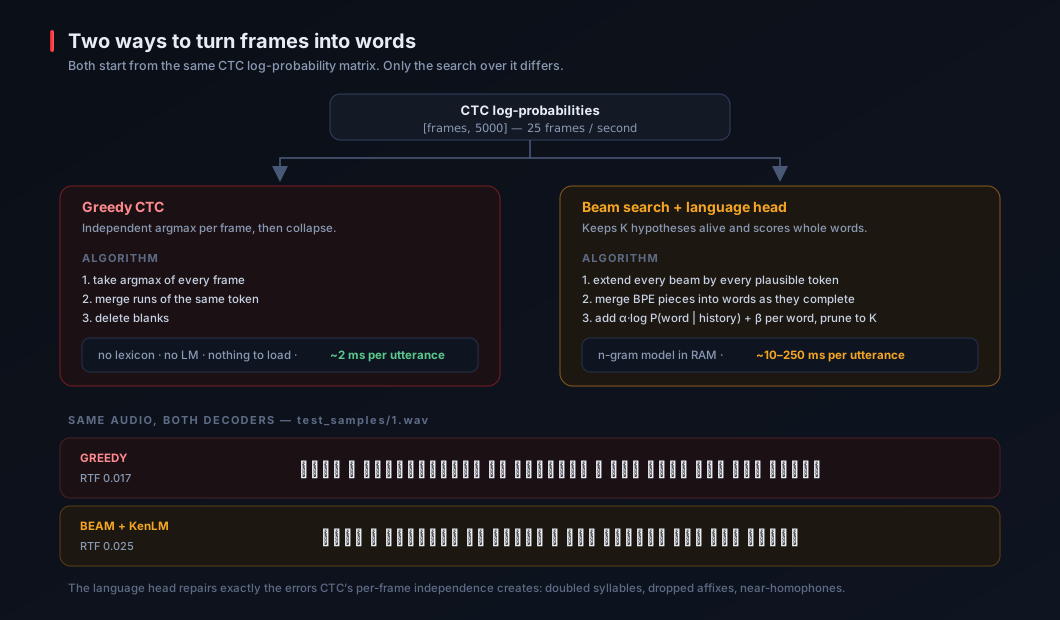
The language head is a separate file with no learned interaction with the acoustic weights.
Swap it, and nothing about `model.pt` changes:
```python
engine = MetroASREngine.from_pretrained("small")
engine.load_lm("lm/medical_head.bin") # swap language heads at run time,
print(engine.transcribe("call.wav", beam_search=True).text) # same acoustic weights throughout
```
**This is measured, not asserted.** The GitHub repo ships two extra language heads —
technical and medical — built from real text (Egyptian medical chat/QA, Egyptian Arabic
Wikipedia's technical articles, real Arabic-English code-switching text) plus synthesised
domain-term carrier phrases, and decodes 11 real clips with all three heads against human
references. Headline results from the
**[full interactive report](https://mohammedaly22.github.io/metro-asr/)**:
| Test set | Greedy | General head | Technical head | Medical head |
|---|---:|---:|---:|---:|
| Technical clips (WER) | 34.8% | 26.2% | **24.1%** | 26.2% |
| Medical clips (WER) | 44.9% | **34.7%** | 38.8% | **34.7%** |
| General speech (WER) | 25.6% | **24.7%** | 36.9% | 32.5% |
Two things worth reading out of that table. The domain heads win in their own domain despite
being 4-grams built from far less text than the general 5-gram — domain fit beats scale for
this component. And the technical head actively *hurts* on general speech (36.9% vs. greedy's
25.6%) — a language head is a strong prior, and matching it to your traffic matters. (These
numbers are from a small, hard 11-clip demo set — unscripted, overlapping speech, dense
code-switching — and are not the same evaluation as the Performance section below; see the
report for methodology.)
Building your own head takes text and minutes, no GPU:
```bash
python scripts/train_lm.py --corpus my_domain.txt --out lm/my_domain_4gram.arpa --order 4
```
Full walkthrough — including a from-scratch corpus-building example for a technical and a
medical domain — in the GitHub README's
[Domain-specialised heads](https://github.com/MohammedAly22/metro-asr#domain-specialised-heads)
section.
---
## Model variants

Three sizes share one block definition and one training recipe — only width, depth and
vocabulary change. **Small (this repository) is the only one currently trained.** Medium and
Large exist as configs in the GitHub repo with exact parameter counts, but no weights —
see [Scaling to Medium and Large](https://github.com/MohammedAly22/metro-asr#scaling-to-medium-and-large)
for what training them actually requires (data volume most of all).
| | Params | d_model | Layers | BPE vocab | Status |
|---|---:|---:|---:|---:|---|
| **Small** | 61.6M | 384 | 12 | 5,000 | **Released — this repo** |
| Medium | 247.4M | 512 | 24 | 8,000 | Config only |
| Large | 747.8M | 768 | 32 | 16,000 | Config only |
---
## Performance
Held-out test-set WER/CER (the numbers in this card's metadata):
| Split | WER (%) | CER (%) |
|---|---:|---:|
| All | 46.85 | 28.41 |
| Arabic only | 37.24 | 17.45 |
| Code-switching | 36.32 | 17.44 |
**Speed** — measured, Intel Core Ultra 7 155H, 4 CPU threads, PyTorch 2.13 CPU build, fp32,
minimum of 15 runs after warm-up:

| Audio length | Latency | RTF | Faster than real time |
|---|---:|---:|---:|
| 1 s | 37 ms | 0.037 | 27× |
| 5 s | 99 ms | 0.020 | 51× |
| **10 s** | **181 ms** | **0.018** | **55×** |
| 30 s | 686 ms | 0.023 | 44× |
Beam search with the 5-gram head adds roughly 10–250 ms per utterance depending on length
(RTF ≈ 0.024 overall). Loading the 5.9 GB binary itself takes about 3.4 s, once, at startup.
---
## Usage
### Install
```bash
pip install metro-asr # greedy decoding only
pip install "metro-asr[lm]" # + KenLM beam search
pip install -U "numpy>=2.0" # see note below
```
> [!WARNING]
> `pyctcdecode`'s only PyPI release pins `numpy<2.0.0` in its own metadata, even though it runs
> fine under numpy 2.x. Installing the `[lm]` extra will downgrade numpy to satisfy that — on an
> environment that already had numpy 2.x with other packages built against it (Colab, most fresh
> installs today), that breaks those packages with `numpy.dtype size changed`. The third line
> above fixes it. If `[lm]` isn't installed at all, `lm_path="auto"` now degrades to greedy with
> a warning rather than crashing engine construction.
### Quick start
```python
from metro_asr import MetroASREngine
engine = MetroASREngine.from_pretrained("small") # auto-downloads weights + tokenizer, caches locally
result = engine.transcribe("audio.wav")
print(result.text)
```
The 5.9 GB language model is **not** downloaded by this call.
### With the language head (beam search)
```python
engine = MetroASREngine.from_pretrained("small", lm_path="auto") # also fetches lm_5gram.bin
result = engine.transcribe("audio.wav", beam_search=True)
print(result.text)
```
### From a manual download
If you've already run `snapshot_download` (or `git clone`d this repo) into a local directory,
point `from_pretrained` at that directory instead — nothing gets re-downloaded, and it works
fully offline:
```python
from huggingface_hub import snapshot_download
from metro_asr import MetroASREngine
snapshot_download(repo_id="MohammedAly22/metro-asr-small", local_dir="checkpoints")
engine = MetroASREngine.from_pretrained("checkpoints", lm_path="auto")
```
> [!TIP]
> This is the fix for a common mistake: calling `from_pretrained("checkpoints")` used to be
> interpreted as a HuggingFace repo id named literally "checkpoints" and fail with
> *Repository Not Found*. Current versions check for an existing local directory first — update
> if you hit that error.
### Without the package — loading the raw PyTorch model
```python
import torch
from metro_asr.utils.config import load_config
from metro_asr.model.metro import MetroASR
from metro_asr.model.tokenizer import build_tokenizer
config = load_config("checkpoints/config.yaml")
tokenizer = build_tokenizer(config, "checkpoints") # must run before MetroASR.from_config —
model = MetroASR.from_config(config) # it fixes the CTC head's vocab size
ckpt = torch.load("checkpoints/model.pt", map_location="cpu", weights_only=False)
model.load_state_dict(ckpt["model_state_dict"])
model.eval()
```
### Batch transcription
```python
results = engine.transcribe_batch(["audio1.wav", "audio2.wav", "audio3.wav"])
for r in results:
print(f"{r.text} (RTF={r.rtf:.4f})")
```
### Streaming and serving
`engine.transcribe_stream(chunk_generator)` yields incremental transcriptions from any audio
generator, and `scripts/serve.py` in the GitHub repo wraps the same engine in a Flask REST API
(`/transcribe`, `/transcribe/batch`, `/health`, `/info`). See the README's
[Streaming](https://github.com/MohammedAly22/metro-asr#streaming) and
[Serving](https://github.com/MohammedAly22/metro-asr#serving) sections, or the runnable
[streaming_server.ipynb](https://github.com/MohammedAly22/metro-asr/blob/main/examples/streaming_server.ipynb)
notebook.
---
## Files in this repository
| File | Description | Size |
|---|---|---:|
| `model.pt` | Checkpoint — weights + AdamW optimizer state | 705 MB |
| `config.yaml` | Model architecture configuration | <1 KB |
| `bpe.model` | SentencePiece BPE tokenizer | 316 KB |
| `bpe.vocab` | Human-readable vocabulary listing | 70 KB |
| `lm_5gram.bin` | KenLM 5-gram general-purpose language head (optional) | 5.9 GB |
Weights alone are 235 MB; `model.pt` is larger because it also carries optimizer state so
training can be resumed from it. Strip that for deployment:
```python
import torch
ckpt = torch.load("model.pt", map_location="cpu", weights_only=False)
torch.save({"model_state_dict": ckpt["model_state_dict"], "config": ckpt["config"]},
"model_inference.pt")
```
---
## Training
- **Audio data:** 130K+ clips from the 8 audio datasets listed in this card's metadata, plus
additional Egyptian Arabic content, covering Arabic-only and Arabic-English code-switching
speech.
- **Text data (for the shipped language head):** ~1.9M Egyptian Arabic sentences plus
Arabic-English code-switching text, upsampled to balance against the larger Arabic-only
portion.
- **Recipe:** CTC loss + 0.3-weighted auxiliary CTC at layer 6, AdamW (β = 0.9, 0.98), linear
warmup into cosine decay, SpecAugment, speed perturbation (0.9×/1.0×/1.1×), 443K steps,
batch size 32 with 4× gradient accumulation, bf16.
- **Hardware:** single GPU.
Full step-by-step instructions to reproduce this from scratch — tokenizer training, language
model training, data preparation, the acoustic training loop, and how to scale the recipe to
Medium/Large — are in the GitHub README's
[Training from scratch](https://github.com/MohammedAly22/metro-asr#training-from-scratch)
section.
### Fine-tuning this checkpoint
Adapting to a new domain or accent starts from these weights, not from scratch — 10-20× lower
learning rate, encoder frozen for the first few thousand steps so the CTC head adapts first:
```bash
python scripts/finetune.py \
--checkpoint checkpoints/model.pt \
--tokenizer-dir checkpoints \
--dataset your/dataset-id \
--lr 5e-5 --max-steps 30000 --freeze-steps 3000
```
Runnable end-to-end in
[fine_tuning.ipynb](https://github.com/MohammedAly22/metro-asr/blob/main/examples/fine_tuning.ipynb)
(Colab, needs a GPU), or see
[Fine-tuning](https://github.com/MohammedAly22/metro-asr#fine-tuning) in the README.
---
## Limitations
- **Dialect.** Trained on Egyptian Arabic; Modern Standard Arabic and other dialects — Gulf,
Levantine, Maghrebi — degrade, Maghrebi most of all.
- **Code-switching is Arabic-English only,** and it's the weakest part of the system:
- Technical/domain vocabulary degrades under plain greedy decoding — see
[The language head](#the-language-head) above for the fix and the measured improvement.
- A lone English word surrounded by Arabic is harder than a full English clause, which
tends to survive intact.
- Acronyms and short initialisms (`CNN`, `MRI`, `AIC`) are acoustically ambiguous and
unreliable without a matching language head.
- Roughly 12K code-switching training utterances were available against ~130K Arabic-only
ones — the imbalance is a data problem, not an architectural one.
- **Clip length.** Trained and evaluated on 0.5–30 s; segment longer recordings before
transcribing.
- **Output is lowercase and unpunctuated**, matching the training transcripts.
- **Not a streaming model in the strict sense** — the encoder is bidirectional, so a chunk
must be complete before it can be decoded. `transcribe_stream` is chunked offline decoding,
with a floor latency of one chunk.
- **The language head is large.** The shipped 5-gram is 5.9 GB resident in RAM; a smaller
4-gram (like the domain heads above) trades some accuracy for a much smaller footprint.
- **The language head asserts priors.** It corrects toward what its training text considers
likely — which is exactly what makes it useful, and exactly how it gets unfamiliar proper
nouns wrong. Train a head on your own text if this matters for your use case.
- **Medium and Large are unreleased.** Their configs exist; no weights do.
---
## Citation
```bibtex
@software{metro_asr_2025,
title = {Metro-ASR: Non-Autoregressive Speech Recognition for Egyptian Arabic
and Code-Switching with a Detachable N-gram Language Head},
author = {Mohammed Aly},
year = {2025},
url = {https://github.com/MohammedAly22/metro-asr}
}
```
## License
MIT — see [LICENSE](https://github.com/MohammedAly22/metro-asr/blob/main/LICENSE).