
The dataset viewer is not available for this split.
Error code: TooBigContentError
Need help to make the dataset viewer work? Make sure to review how to configure the dataset viewer, and open a discussion for direct support.
Dataset Card for base0
This is the dataset originally used for training Panda: Patched Attention for Nonlinear Dynamics.
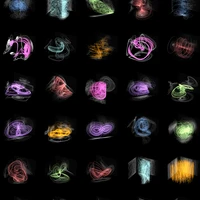
Details: Each subdirectory is the base (parent) system. The files in each subdirectory correspond to random parameter perturbations of the original systems. We call this dataset "base40" because each system is integrated with 40 periods (on a Fourier timescale, determined by the original unperturbed system). See the dysts repo for more details.
NOTE: we are working on a larger and improved dataset, with improved filtering for chaotic behavior. Stay tuned!
Paper abstract:
Chaotic systems are intrinsically sensitive to small errors, challenging efforts to construct predictive data-driven models of real-world dynamical systems such as fluid flows or neuronal activity. Prior efforts comprise either specialized models trained separately on individual time series, or foundation models trained on vast time series databases with little underlying dynamical structure. Motivated by dynamical systems theory, we present Panda, Patched Attention for Nonlinear DynAmics. We train Panda on a novel synthetic, extensible dataset of 2 \times 10^4 chaotic dynamical systems that we discover using an evolutionary algorithm. Trained purely on simulated data, Panda exhibits emergent properties: zero-shot forecasting of unseen real world chaotic systems, and nonlinear resonance patterns in cross-channel attention heads. Despite having been trained only on low-dimensional ordinary differential equations, Panda spontaneously develops the ability to predict partial differential equations without retraining. We demonstrate a neural scaling law for differential equations, underscoring the potential of pretrained models for probing abstract mathematical domains like nonlinear dynamics.
- Preprint: arXiv:2505.13755
- Repository: https://github.com/abao1999/panda
Citation
BibTeX:
If you find our work valuable for your research, please cite us:
@misc{lai2025panda,
      title={Panda: A pretrained forecast model for universal representation of chaotic dynamics},
      author={Jeffrey Lai and Anthony Bao and William Gilpin},
      year={2025},
      eprint={2505.13755},
      archivePrefix={arXiv},
      primaryClass={cs.LG},
      url={https://arxiv.org/abs/2505.13755},
}
- Downloads last month
- 12