
Transformers documentation
GLM-5.3-Flash
This model was contributed to Hugging Face Transformers on 2026-08-26.
GLM-5.3-Flash
Overview
The GLM-5.3-Flash model use this class. The implementation in transformers does not include an MTP layer.
GLM-5.3-Flash
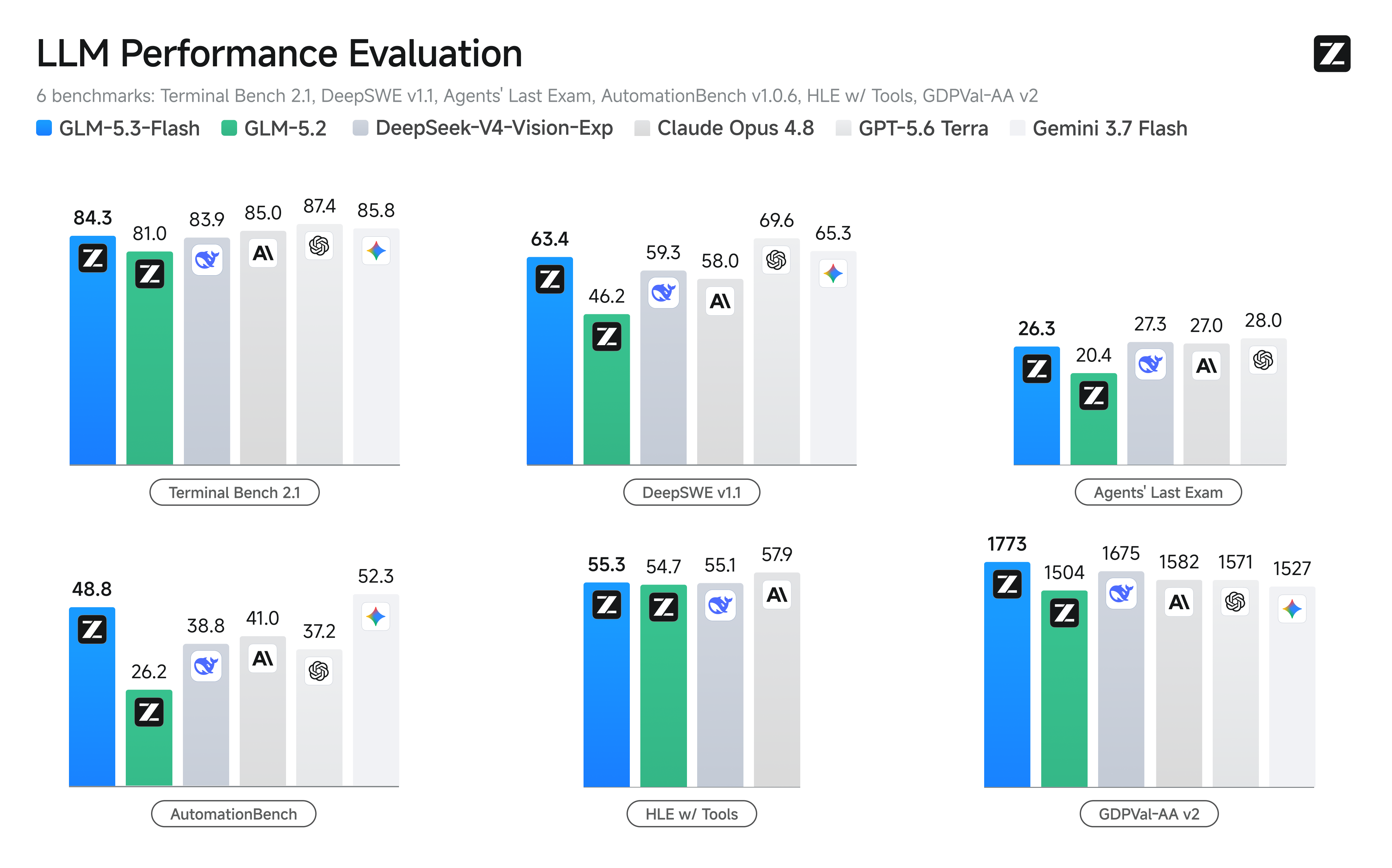
GLM-5.3-Flash, the first natively multimodal model in the GLM-5 series. With 320B total parameters and just 18B active parameters, it outperforms GLM-5.2 across benchmarks and real-world workloads at one-tenth the price, while approaching Claude Opus 4.8 on coding and agentic benchmarks.
GLM-5.3-Flash starts from a newly trained base model, with its architecture and training recipe redesigned around capability and efficiency. For the first time in the GLM series, we introduce a hybrid architecture combining sparse and linear attention, sharply reducing long-context serving costs while preserving precise long-context capabilities. The model also adopts Manifold-Constrained Hyper-Connections (mHC) to further improve scaling efficiency. Together with our latest 30T-token multimodal pre-training corpus, these changes enable GLM-5.3-Flash to deliver more intelligence with less compute.
Glm5NextConfig
class transformers.Glm5NextConfig
< source >( transformers_version: str | None = Nonearchitectures: list[str] | None = Noneoutput_hidden_states: bool | None = Falsereturn_dict: bool | None = Truedtype: typing.Union[str, ForwardRef('torch.dtype'), NoneType] = Nonechunk_size_feed_forward: int = 0is_encoder_decoder: bool = Falseid2label: dict[int, str] | dict[str, str] | None = Nonelabel2id: dict[str, int] | dict[str, str] | None = Noneproblem_type: typing.Optional[typing.Literal['regression', 'single_label_classification', 'multi_label_classification']] = Nonetext_config: dict | transformers.configuration_utils.PreTrainedConfig | None = Nonevision_config: dict | transformers.configuration_utils.PreTrainedConfig | None = Noneimage_token_id: int = 154854video_token_id: int = 154855image_start_token_id: int = 154830image_end_token_id: int = 154831video_start_token_id: int = 154832video_end_token_id: int = 154833tie_word_embeddings: bool = False )
Parameters
- text_config (
Union[dict, ~configuration_utils.PreTrainedConfig], optional) — The config object or dictionary of the text backbone. - vision_config (
Union[dict, ~configuration_utils.PreTrainedConfig], optional) — The config object or dictionary of the vision backbone. - image_token_id (
int, optional, defaults to 154854) — The image token index to encode the image prompt. - video_token_id (
int, optional, defaults to 154855) — The video token index to encode the video prompt. - image_start_token_id (
int, optional, defaults to 154830) — The image start token index to encode the start of image. - image_end_token_id (
int, optional, defaults to 154831) — The image end token index to encode the end of image. - video_start_token_id (
int, optional, defaults to 154832) — The video start token index to encode the start of video. - video_end_token_id (
int, optional, defaults to 154833) — The video end token index to encode the end of video. - tie_word_embeddings (
bool, optional, defaults toFalse) — Whether to tie weight embeddings according to model’stied_weights_keysmapping.
This is the configuration class to store the configuration of a Glm5NextModel. It is used to instantiate a Glm5 Next model according to the specified arguments, defining the model architecture. Instantiating a configuration with the defaults will yield a similar configuration to that of the zai-org/GLM-5.3-Flash
Configuration objects inherit from PreTrainedConfig and can be used to control the model outputs. Read the documentation from PreTrainedConfig for more information.
Glm5NextTextConfig
class transformers.Glm5NextTextConfig
< source >( transformers_version: str | None = Nonearchitectures: list[str] | None = Noneoutput_hidden_states: bool | None = Falsereturn_dict: bool | None = Truedtype: typing.Union[str, ForwardRef('torch.dtype'), NoneType] = Nonechunk_size_feed_forward: int = 0is_encoder_decoder: bool = Falseid2label: dict[int, str] | dict[str, str] | None = Nonelabel2id: dict[str, int] | dict[str, str] | None = Noneproblem_type: typing.Optional[typing.Literal['regression', 'single_label_classification', 'multi_label_classification']] = Nonevocab_size: int = 154880hidden_size: int = 4096intermediate_size: int = 12288moe_intermediate_size: int = 2048num_hidden_layers: int = 45num_attention_heads: int = 64num_key_value_heads: int = 64n_shared_experts: int = 1n_routed_experts: int = 288routed_scaling_factor: float = 2.5kv_lora_rank: int = 512q_lora_rank: int = 1536qk_rope_head_dim: int = 0v_head_dim: int = 256qk_nope_head_dim: int = 256n_group: int = 1topk_group: int = 1num_experts_per_tok: int = 8norm_topk_prob: bool = Truehidden_act: str = 'silu'max_position_embeddings: int = 1048576initializer_range: float = 0.02rms_norm_eps: float = 1e-05use_cache: bool = Truepad_token_id: int | None = 154820bos_token_id: int | None = Noneeos_token_id: int | list[int] | None = Nonetie_word_embeddings: bool = Falsemlp_layer_types: list[str] | None = Noneattention_bias: bool = Falseattention_dropout: float | int = 0.0index_topk: int = 2048index_head_dim: int = 128index_n_heads: int = 32head_dim: int = 0layer_types: list[str] | None = Noneindexer_types: list[str] | None = Noneswiglu_limit: float = 10.0linear_head_dim: int = 128linear_num_heads: int = 64linear_conv_kernel_dim: int = 4linear_lower_bound: float | None = -5.0hc_mult: int = 4hc_eps: float = 1e-06hc_sinkhorn_iters: int = 20output_router_logits: bool = Falserouter_aux_loss_coef: float = 0.001index_kpool: int = 16index_kpool_always_select_tail: bool = True )
Parameters
- vocab_size (
int, optional, defaults to154880) — Vocabulary size of the model. Defines the number of different tokens that can be represented by theinput_ids. - hidden_size (
int, optional, defaults to4096) — Dimension of the hidden representations. - intermediate_size (
int, optional, defaults to12288) — Dimension of the MLP representations. - moe_intermediate_size (
int, optional, defaults to2048) — Intermediate size of the routed expert MLPs. - num_hidden_layers (
int, optional, defaults to45) — Number of hidden layers in the Transformer decoder. - num_attention_heads (
int, optional, defaults to64) — Number of attention heads for each attention layer in the Transformer decoder. - num_key_value_heads (
int, optional, defaults to64) — This is the number of key_value heads that should be used to implement Grouped Query Attention. Ifnum_key_value_heads=num_attention_heads, the model will use Multi Head Attention (MHA), ifnum_key_value_heads=1the model will use Multi Query Attention (MQA) otherwise GQA is used. When converting a multi-head checkpoint to a GQA checkpoint, each group key and value head should be constructed by meanpooling all the original heads within that group. For more details, check out this paper. If it is not specified, will default tonum_attention_heads. - n_shared_experts (
int, optional, defaults to1) — Number of shared experts. - n_routed_experts (
int, optional, defaults to288) — Number of routed experts. - routed_scaling_factor (
float, optional, defaults to2.5) — Scaling factor or routed experts. - kv_lora_rank (
int, optional, defaults to512) — Rank of the LoRA matrices for key and value projections. - q_lora_rank (
int, optional, defaults to1536) — Rank of the LoRA matrices for query projections. - qk_rope_head_dim (
int, optional, defaults to0) — Dimension of the query/key heads that use rotary position embeddings. - v_head_dim (
int, optional, defaults to256) — Dimension of the value heads. - qk_nope_head_dim (
int, optional, defaults to256) — Dimension of the query/key heads that don’t use rotary position embeddings. - n_group (
int, optional, defaults to 1) — Number of routed expert groups. - topk_group (
int, optional, defaults to1) — Number of selected groups for each token (for each token, ensuring the selected experts is only withintopk_groupgroups). - num_experts_per_tok (
int, optional, defaults to8) — Number of experts to route each token to. This is the top-k value for the token-choice routing. - norm_topk_prob (
bool, optional, defaults toTrue) — Whether to normalize the weights of the routed experts. - hidden_act (
str, optional, defaults tosilu) — The non-linear activation function (function or string) in the decoder. For example,"gelu","relu","silu", etc. - max_position_embeddings (
int, optional, defaults to1048576) — The maximum sequence length that this model might ever be used with. - initializer_range (
float, optional, defaults to0.02) — The standard deviation of the truncated_normal_initializer for initializing all weight matrices. - rms_norm_eps (
float, optional, defaults to1e-05) — The epsilon used by the rms normalization layers. - use_cache (
bool, optional, defaults toTrue) — Whether or not the model should return the last key/values attentions (not used by all models). Only relevant ifconfig.is_decoder=Trueor when the model is a decoder-only generative model. - pad_token_id (
int, optional, defaults to154820) — Token id used for padding in the vocabulary. - bos_token_id (
int, optional) — Token id used for beginning-of-stream in the vocabulary. - eos_token_id (
Union[int, list[int]], optional) — Token id used for end-of-stream in the vocabulary. - tie_word_embeddings (
bool, optional, defaults toFalse) — Whether to tie weight embeddings according to model’stied_weights_keysmapping. - mlp_layer_types (
list[str], optional) — Per-layer feed-forward schedule. Values are"dense"or"sparse". - attention_bias (
bool, optional, defaults toFalse) — Whether to use a bias in the query, key, value and output projection layers during self-attention. - attention_dropout (
Union[float, int], optional, defaults to0.0) — The dropout ratio for the attention probabilities. - index_topk (
int, optional, defaults to 2048) — Number of sparse-attention positions selected by the DSA indexer. - index_head_dim (
int, optional, defaults to 128) — DSA indexer projection head dimension. - index_n_heads (
int, optional, defaults to 32) — Number of DSA indexer heads. - head_dim (
int, optional, defaults to0) — The attention head dimension. If None, it will default to hidden_size // num_attention_heads - layer_types (
list[str], optional) — Per-layer attention cache schedule. Values are"linear_attention"for KDA layers and"deepseek_sparse_attention"for MLA (DSA) layers. - indexer_types (
list[str], optional) — Per-layer DSA indexer mode. Values are"full"(run the indexer) or"shared"(reuse the previous full layer’s top-k selection). - swiglu_limit (
float, optional, defaults to 10.0) — Clamp limit applied to SwiGLU gate/up projections. - linear_head_dim (
int, optional, defaults to 128) — Dimension of each head in linear attention. - linear_num_heads (
int, optional, defaults to 64) — Number of heads used in linear attention layers. - linear_conv_kernel_dim (
int, optional, defaults to 4) — Kernel size of the convolution used in linear attention layers. - linear_lower_bound (
float, optional, defaults to -5.0) — Whether the forget gate has a lower bound to apply to the decay. - hc_mult (
int, optional, defaults to 4) — Number of MHC residual streams. - hc_eps (
float, optional, defaults to 1e-6) — Numerical floor used by MHC Sinkhorn normalization. - hc_sinkhorn_iters (
int, optional, defaults to 20) — Number of Sinkhorn iterations used by MHC routing. - output_router_logits (
bool, optional, defaults toFalse) — Whether or not the router logits should be returned by the model. Enabling this will also allow the model to output the auxiliary loss, including load balancing loss and router z-loss. - router_aux_loss_coef (
float, optional, defaults to0.001) — Auxiliary load balancing loss coefficient. Used to penalize uneven expert routing in MoE models. - index_kpool (
int, optional, defaults to 16) — Pool size of the compressed token groups selected by the DSA indexer. - index_kpool_always_select_tail (
bool, optional, defaults toTrue) — Whether the incomplete KPool tail is always included in sparse attention.
This is the configuration class to store the configuration of a Glm5NextModel. It is used to instantiate a Glm5 Next model according to the specified arguments, defining the model architecture. Instantiating a configuration with the defaults will yield a similar configuration to that of the zai-org/GLM-5.3-Flash
Configuration objects inherit from PreTrainedConfig and can be used to control the model outputs. Read the documentation from PreTrainedConfig for more information.
Glm5NextVisionConfig
class transformers.Glm5NextVisionConfig
< source >( transformers_version: str | None = Nonearchitectures: list[str] | None = Noneoutput_hidden_states: bool | None = Falsereturn_dict: bool | None = Truedtype: typing.Union[str, ForwardRef('torch.dtype'), NoneType] = Nonechunk_size_feed_forward: int = 0is_encoder_decoder: bool = Falseid2label: dict[int, str] | dict[str, str] | None = Nonelabel2id: dict[str, int] | dict[str, str] | None = Noneproblem_type: typing.Optional[typing.Literal['regression', 'single_label_classification', 'multi_label_classification']] = Nonedepth: int = 24hidden_size: int = 1024hidden_act: str = 'silu'attention_bias: bool = Trueattention_dropout: float | int = 0.0num_heads: int = 16in_channels: int = 3image_size: int | list[int] | tuple[int, int] = 336patch_size: int | list[int] | tuple[int, int] = 14rms_norm_eps: float = 1e-05spatial_merge_size: int = 2temporal_patch_size: int | list[int] | tuple[int, int] = 2out_hidden_size: int = 1536intermediate_size: int = 4096initializer_range: float = 0.02projection_intermediate_size: int = 10240swiglu_limit: float = 10.0 )
Parameters
- depth (
int, optional, defaults to24) — Number of Transformer layers in the vision encoder. - hidden_size (
int, optional, defaults to1024) — Dimension of the hidden representations. - hidden_act (
str, optional, defaults tosilu) — The non-linear activation function (function or string) in the decoder. For example,"gelu","relu","silu", etc. - attention_bias (
bool, optional, defaults toTrue) — Whether to use a bias in the query, key, value and output projection layers during self-attention. - attention_dropout (
Union[float, int], optional, defaults to0.0) — The dropout ratio for the attention probabilities. - num_heads (
int, optional, defaults to16) — Number of attention heads for each attention layer in the Transformer decoder. - in_channels (
int, optional, defaults to3) — The number of input channels. - image_size (
Union[int, list[int], tuple[int, int]], optional, defaults to336) — The size (resolution) of each image. - patch_size (
Union[int, list[int], tuple[int, int]], optional, defaults to14) — The size (resolution) of each patch. - rms_norm_eps (
float, optional, defaults to1e-05) — The epsilon used by the rms normalization layers. - spatial_merge_size (
int, optional, defaults to2) — The size of the spatial merge window used to reduce the number of visual tokens by merging neighboring patches. - temporal_patch_size (
Union[int, list[int], tuple[int, int]], optional, defaults to2) — Temporal patch size used in the 3D patch embedding for video inputs. - out_hidden_size (
int, optional, defaults to 1536) — The output hidden size of the vision model. - intermediate_size (
int, optional, defaults to4096) — Dimension of the MLP representations. - initializer_range (
float, optional, defaults to0.02) — The standard deviation of the truncated_normal_initializer for initializing all weight matrices. - projection_intermediate_size (
int, optional, defaults to 10240) — The projection_intermediate_size size for the vision patch merger. - swiglu_limit (
float, optional, defaults to 10.0) — Clamp limit applied to the vision SwiGLU gate/up projections.
This is the configuration class to store the configuration of a Glm5NextModel. It is used to instantiate a Glm5 Next model according to the specified arguments, defining the model architecture. Instantiating a configuration with the defaults will yield a similar configuration to that of the zai-org/GLM-5.3-Flash
Configuration objects inherit from PreTrainedConfig and can be used to control the model outputs. Read the documentation from PreTrainedConfig for more information.
Glm5NextPreTrainedModel
class transformers.Glm5NextPreTrainedModel
< source >( config: PreTrainedConfig*inputs**kwargs )
Parameters
- config (PreTrainedConfig) — Model configuration class with all the parameters of the model. Initializing with a config file does not load the weights associated with the model, only the configuration. Check out the from_pretrained() method to load the model weights.
This model inherits from PreTrainedModel. Check the superclass documentation for the generic methods the library implements for all its model (such as downloading or saving, resizing the input embeddings, pruning heads etc.)
This model is also a PyTorch torch.nn.Module subclass. Use it as a regular PyTorch Module and refer to the PyTorch documentation for all matter related to general usage and behavior.
A mock value for a dotted path (e.g. torch.float32): attribute access chains,
calls behave as pass-through decorators, repr is the dotted path, and using it
as a base class substitutes a plain-type base (PEP 560 __mro_entries__), so
real subclasses keep a normal metaclass and inspect.signature reads their real __init__ instead of a mock’s.
Glm5NextTextModel
class transformers.Glm5NextTextModel
< source >( config )
Parameters
- config (Glm5NextTextModel) — Model configuration class with all the parameters of the model. Initializing with a config file does not load the weights associated with the model, only the configuration. Check out the from_pretrained() method to load the model weights.
The bare Glm5 Next Text Model outputting raw hidden-states without any specific head on top.
This model inherits from PreTrainedModel. Check the superclass documentation for the generic methods the library implements for all its model (such as downloading or saving, resizing the input embeddings, pruning heads etc.)
This model is also a PyTorch torch.nn.Module subclass. Use it as a regular PyTorch Module and refer to the PyTorch documentation for all matter related to general usage and behavior.
forward
< source >( input_ids: typing.Optional[torch.LongTensor] = Noneattention_mask: typing.Optional[torch.Tensor] = Noneposition_ids: typing.Optional[torch.LongTensor] = Nonepast_key_values: transformers.cache_utils.Cache | None = Noneinputs_embeds: typing.Optional[torch.FloatTensor] = Noneuse_cache: bool | None = None**kwargs: Unpack ) → MoeModelOutputWithPast or tuple(torch.FloatTensor)
Parameters
- input_ids (
torch.LongTensorof shape(batch_size, sequence_length), optional) — Indices of input sequence tokens in the vocabulary. Padding will be ignored by default.Indices can be obtained using AutoTokenizer. See PreTrainedTokenizer.encode() and PreTrainedTokenizer.call() for details.
- attention_mask (
torch.Tensorof shape(batch_size, sequence_length), optional) — Mask to avoid performing attention on padding token indices. Mask values selected in[0, 1]:- 1 for tokens that are not masked,
- 0 for tokens that are masked.
- position_ids (
torch.LongTensorof shape(batch_size, sequence_length), optional) — Indices of positions of each input sequence tokens in the position embeddings. Selected in the range[0, config.n_positions - 1]. - past_key_values (
~cache_utils.Cache, optional) — Pre-computed hidden-states (key and values in the self-attention blocks and in the cross-attention blocks) that can be used to speed up sequential decoding. This typically consists in thepast_key_valuesreturned by the model at a previous stage of decoding, whenuse_cache=Trueorconfig.use_cache=True.Only Cache instance is allowed as input, see our kv cache guide. If no
past_key_valuesare passed, DynamicCache will be initialized by default.The model will output the same cache format that is fed as input.
If
past_key_valuesare used, the user is expected to input only unprocessedinput_ids(those that don’t have their past key value states given to this model) of shape(batch_size, unprocessed_length)instead of allinput_idsof shape(batch_size, sequence_length). - inputs_embeds (
torch.FloatTensorof shape(batch_size, sequence_length, hidden_size), optional) — Optionally, instead of passinginput_idsyou can choose to directly pass an embedded representation. This is useful if you want more control over how to convertinput_idsindices into associated vectors than the model’s internal embedding lookup matrix. - use_cache (
bool, optional) — If set toTrue,past_key_valueskey value states are returned and can be used to speed up decoding (seepast_key_values).
Returns
MoeModelOutputWithPast or tuple(torch.FloatTensor)
A MoeModelOutputWithPast or a tuple of
torch.FloatTensor (if return_dict=False is passed or when config.return_dict=False) comprising various
elements depending on the configuration (Glm5NextConfig) and inputs.
The Glm5NextTextModel forward method, overrides the __call__ special method.
Although the recipe for forward pass needs to be defined within this function, one should call the
Moduleinstance afterwards instead of this since the former takes care of running the pre and post processing steps while the latter silently ignores them.
last_hidden_state (
torch.FloatTensorof shape(batch_size, sequence_length, hidden_size)) — Sequence of hidden-states at the output of the last layer of the model.past_key_values (
Cache, optional, returned whenuse_cache=Trueis passed or whenconfig.use_cache=True) — It is a Cache instance. For more details, see our kv cache guide.Contains pre-computed hidden-states (key and values in the self-attention blocks and optionally if
config.is_encoder_decoder=Truein the cross-attention blocks) that can be used (seepast_key_valuesinput) to speed up sequential decoding.hidden_states (
tuple(torch.FloatTensor), optional, returned whenoutput_hidden_states=Trueis passed or whenconfig.output_hidden_states=True) — Tuple oftorch.FloatTensor(one for the output of the embeddings, if the model has an embedding layer, + one for the output of each layer) of shape(batch_size, sequence_length, hidden_size).Hidden-states of the model at the output of each layer plus the optional initial embedding outputs.
attentions (
tuple(torch.FloatTensor), optional, returned whenoutput_attentions=Trueis passed or whenconfig.output_attentions=True) — Tuple oftorch.FloatTensor(one for each layer) of shape(batch_size, num_heads, sequence_length, sequence_length).Attentions weights after the attention softmax, used to compute the weighted average in the self-attention heads.
router_logits (
tuple(torch.FloatTensor), optional, returned whenoutput_router_probs=Trueandconfig.add_router_probs=Trueis passed or whenconfig.output_router_probs=True) — Tuple oftorch.FloatTensor(one for each layer) of shape(batch_size, sequence_length, num_experts).Raw router logits (post-softmax) that are computed by MoE routers, these terms are used to compute the auxiliary loss for Mixture of Experts models.
Glm5NextModel
Glm5NextVisionModel
class transformers.Glm5NextVisionModel
< source >( config )
Parameters
- config (Glm5NextVisionModel) — Model configuration class with all the parameters of the model. Initializing with a config file does not load the weights associated with the model, only the configuration. Check out the from_pretrained() method to load the model weights.
The bare Glm5 Next Model outputting raw hidden-states without any specific head on top.
This model inherits from PreTrainedModel. Check the superclass documentation for the generic methods the library implements for all its model (such as downloading or saving, resizing the input embeddings, pruning heads etc.)
This model is also a PyTorch torch.nn.Module subclass. Use it as a regular PyTorch Module and refer to the PyTorch documentation for all matter related to general usage and behavior.
forward
< source >( hidden_states: Tensorgrid_thw: Tensor**kwargs ) → torch.Tensor
The Glm5NextVisionModel forward method, overrides the __call__ special method.
Although the recipe for forward pass needs to be defined within this function, one should call the
Moduleinstance afterwards instead of this since the former takes care of running the pre and post processing steps while the latter silently ignores them.
class transformers.Glm5NextModel
< source >( config )
Parameters
- config (Glm5NextModel) — Model configuration class with all the parameters of the model. Initializing with a config file does not load the weights associated with the model, only the configuration. Check out the from_pretrained() method to load the model weights.
The bare Glm5 Next Model outputting raw hidden-states without any specific head on top.
This model inherits from PreTrainedModel. Check the superclass documentation for the generic methods the library implements for all its model (such as downloading or saving, resizing the input embeddings, pruning heads etc.)
This model is also a PyTorch torch.nn.Module subclass. Use it as a regular PyTorch Module and refer to the PyTorch documentation for all matter related to general usage and behavior.
forward
< source >( input_ids: typing.Optional[torch.LongTensor] = Noneattention_mask: typing.Optional[torch.Tensor] = Noneposition_ids: typing.Optional[torch.LongTensor] = Nonepast_key_values: transformers.cache_utils.Cache | None = Noneinputs_embeds: typing.Optional[torch.FloatTensor] = Noneuse_cache: bool | None = Nonepixel_values: typing.Optional[torch.Tensor] = Nonepixel_values_videos: typing.Optional[torch.FloatTensor] = Noneimage_grid_thw: typing.Optional[torch.LongTensor] = Nonevideo_grid_thw: typing.Optional[torch.LongTensor] = None**kwargs: Unpack ) → BaseModelOutputWithPast or tuple(torch.FloatTensor)
Parameters
- input_ids (
torch.LongTensorof shape(batch_size, sequence_length), optional) — Indices of input sequence tokens in the vocabulary. Padding will be ignored by default.Indices can be obtained using AutoTokenizer. See PreTrainedTokenizer.encode() and PreTrainedTokenizer.call() for details.
- attention_mask (
torch.Tensorof shape(batch_size, sequence_length), optional) — Mask to avoid performing attention on padding token indices. Mask values selected in[0, 1]:- 1 for tokens that are not masked,
- 0 for tokens that are masked.
- position_ids (
torch.LongTensorof shape(batch_size, sequence_length), optional) — Indices of positions of each input sequence tokens in the position embeddings. Selected in the range[0, config.n_positions - 1]. - past_key_values (
~cache_utils.Cache, optional) — Pre-computed hidden-states (key and values in the self-attention blocks and in the cross-attention blocks) that can be used to speed up sequential decoding. This typically consists in thepast_key_valuesreturned by the model at a previous stage of decoding, whenuse_cache=Trueorconfig.use_cache=True.Only Cache instance is allowed as input, see our kv cache guide. If no
past_key_valuesare passed, DynamicCache will be initialized by default.The model will output the same cache format that is fed as input.
If
past_key_valuesare used, the user is expected to input only unprocessedinput_ids(those that don’t have their past key value states given to this model) of shape(batch_size, unprocessed_length)instead of allinput_idsof shape(batch_size, sequence_length). - inputs_embeds (
torch.FloatTensorof shape(batch_size, sequence_length, hidden_size), optional) — Optionally, instead of passinginput_idsyou can choose to directly pass an embedded representation. This is useful if you want more control over how to convertinput_idsindices into associated vectors than the model’s internal embedding lookup matrix. - use_cache (
bool, optional) — If set toTrue,past_key_valueskey value states are returned and can be used to speed up decoding (seepast_key_values). - pixel_values (
torch.Tensorof shape(batch_size, num_channels, image_size, image_size), optional) — The tensors corresponding to the input images. Pixel values can be obtained using Glm5NextImageProcessor. SeeGlm5NextImageProcessor.__call__()for details (Glm5NextProcessor uses Glm5NextImageProcessor for processing images). - pixel_values_videos (
torch.FloatTensorof shape(batch_size, num_frames, num_channels, frame_size, frame_size), optional) — The tensors corresponding to the input video. Pixel values for videos can be obtained using Glm5NextVideoProcessor. SeeGlm5NextVideoProcessor.__call__()for details (Glm5NextProcessor uses Glm5NextVideoProcessor for processing videos). - image_grid_thw (
torch.LongTensorof shape(num_images, 3), optional) — The temporal, height and width of feature shape of each image in LLM. - video_grid_thw (
torch.LongTensorof shape(num_videos, 3), optional) — The temporal, height and width of feature shape of each video in LLM.
Returns
BaseModelOutputWithPast or tuple(torch.FloatTensor)
A BaseModelOutputWithPast or a tuple of
torch.FloatTensor (if return_dict=False is passed or when config.return_dict=False) comprising various
elements depending on the configuration (Glm5NextConfig) and inputs.
The Glm5NextModel forward method, overrides the __call__ special method.
Although the recipe for forward pass needs to be defined within this function, one should call the
Moduleinstance afterwards instead of this since the former takes care of running the pre and post processing steps while the latter silently ignores them.
last_hidden_state (
torch.FloatTensorof shape(batch_size, sequence_length, hidden_size)) — Sequence of hidden-states at the output of the last layer of the model.If
past_key_valuesis used only the last hidden-state of the sequences of shape(batch_size, 1, hidden_size)is output.past_key_values (
Cache, optional, returned whenuse_cache=Trueis passed or whenconfig.use_cache=True) — It is a Cache instance. For more details, see our kv cache guide.Contains pre-computed hidden-states (key and values in the self-attention blocks and optionally if
config.is_encoder_decoder=Truein the cross-attention blocks) that can be used (seepast_key_valuesinput) to speed up sequential decoding.hidden_states (
tuple(torch.FloatTensor), optional, returned whenoutput_hidden_states=Trueis passed or whenconfig.output_hidden_states=True) — Tuple oftorch.FloatTensor(one for the output of the embeddings, if the model has an embedding layer, + one for the output of each layer) of shape(batch_size, sequence_length, hidden_size).Hidden-states of the model at the output of each layer plus the optional initial embedding outputs.
attentions (
tuple(torch.FloatTensor), optional, returned whenoutput_attentions=Trueis passed or whenconfig.output_attentions=True) — Tuple oftorch.FloatTensor(one for each layer) of shape(batch_size, num_heads, sequence_length, sequence_length).Attentions weights after the attention softmax, used to compute the weighted average in the self-attention heads.
Glm5NextForConditionalGeneration
class transformers.Glm5NextForConditionalGeneration
< source >( config )
Parameters
- config (Glm5NextForConditionalGeneration) — Model configuration class with all the parameters of the model. Initializing with a config file does not load the weights associated with the model, only the configuration. Check out the from_pretrained() method to load the model weights.
The Glm5 Next Model for token generation conditioned on other modalities (e.g. image-text-to-text generation).
This model inherits from PreTrainedModel. Check the superclass documentation for the generic methods the library implements for all its model (such as downloading or saving, resizing the input embeddings, pruning heads etc.)
This model is also a PyTorch torch.nn.Module subclass. Use it as a regular PyTorch Module and refer to the PyTorch documentation for all matter related to general usage and behavior.
forward
< source >( input_ids: typing.Optional[torch.LongTensor] = Noneattention_mask: typing.Optional[torch.Tensor] = Noneposition_ids: typing.Optional[torch.LongTensor] = Nonepast_key_values: transformers.cache_utils.Cache | None = Noneinputs_embeds: typing.Optional[torch.FloatTensor] = Nonelabels: typing.Optional[torch.LongTensor] = Noneuse_cache: bool | None = Nonepixel_values: typing.Optional[torch.Tensor] = Nonepixel_values_videos: typing.Optional[torch.FloatTensor] = Noneimage_grid_thw: typing.Optional[torch.LongTensor] = Nonevideo_grid_thw: typing.Optional[torch.LongTensor] = Noneoutput_router_logits: bool | None = Nonemm_token_type_ids: typing.Optional[torch.IntTensor] = Nonelogits_to_keep: typing.Union[int, torch.Tensor] = 0**kwargs: Unpack ) → MoeCausalLMOutputWithPast or tuple(torch.FloatTensor)
Parameters
- input_ids (
torch.LongTensorof shape(batch_size, sequence_length), optional) — Indices of input sequence tokens in the vocabulary. Padding will be ignored by default.Indices can be obtained using AutoTokenizer. See PreTrainedTokenizer.encode() and PreTrainedTokenizer.call() for details.
- attention_mask (
torch.Tensorof shape(batch_size, sequence_length), optional) — Mask to avoid performing attention on padding token indices. Mask values selected in[0, 1]:- 1 for tokens that are not masked,
- 0 for tokens that are masked.
- position_ids (
torch.LongTensorof shape(batch_size, sequence_length), optional) — Indices of positions of each input sequence tokens in the position embeddings. Selected in the range[0, config.n_positions - 1]. - past_key_values (
~cache_utils.Cache, optional) — Pre-computed hidden-states (key and values in the self-attention blocks and in the cross-attention blocks) that can be used to speed up sequential decoding. This typically consists in thepast_key_valuesreturned by the model at a previous stage of decoding, whenuse_cache=Trueorconfig.use_cache=True.Only Cache instance is allowed as input, see our kv cache guide. If no
past_key_valuesare passed, DynamicCache will be initialized by default.The model will output the same cache format that is fed as input.
If
past_key_valuesare used, the user is expected to input only unprocessedinput_ids(those that don’t have their past key value states given to this model) of shape(batch_size, unprocessed_length)instead of allinput_idsof shape(batch_size, sequence_length). - inputs_embeds (
torch.FloatTensorof shape(batch_size, sequence_length, hidden_size), optional) — Optionally, instead of passinginput_idsyou can choose to directly pass an embedded representation. This is useful if you want more control over how to convertinput_idsindices into associated vectors than the model’s internal embedding lookup matrix. - labels (
torch.LongTensorof shape(batch_size, sequence_length), optional) — Labels for computing the masked language modeling loss. Indices should either be in[0, ..., config.vocab_size]or -100 (seeinput_idsdocstring). Tokens with indices set to-100are ignored (masked), the loss is only computed for the tokens with labels in[0, ..., config.vocab_size]. - use_cache (
bool, optional) — If set toTrue,past_key_valueskey value states are returned and can be used to speed up decoding (seepast_key_values). - pixel_values (
torch.Tensorof shape(batch_size, num_channels, image_size, image_size), optional) — The tensors corresponding to the input images. Pixel values can be obtained using Glm5NextImageProcessor. SeeGlm5NextImageProcessor.__call__()for details (Glm5NextProcessor uses Glm5NextImageProcessor for processing images). - pixel_values_videos (
torch.FloatTensorof shape(batch_size, num_frames, num_channels, frame_size, frame_size), optional) — The tensors corresponding to the input video. Pixel values for videos can be obtained using Glm5NextVideoProcessor. SeeGlm5NextVideoProcessor.__call__()for details (Glm5NextProcessor uses Glm5NextVideoProcessor for processing videos). - image_grid_thw (
torch.LongTensorof shape(num_images, 3), optional) — The temporal, height and width of feature shape of each image in LLM. - video_grid_thw (
torch.LongTensorof shape(num_videos, 3), optional) — The temporal, height and width of feature shape of each video in LLM. - output_router_logits (
bool, optional) — Whether or not to return the logits of all the routers. They are useful for computing the router loss, and should not be returned during inference. - mm_token_type_ids (
torch.IntTensorof shape(batch_size, sequence_length), optional) — Indices of input sequence tokens matching each modality. For example text (0), image (1), video (2). Multimodal token type ids can be obtained using AutoProcessor. See ProcessorMixin.call() for details. - logits_to_keep (
Union[int, torch.Tensor], optional, defaults to0) — If anint, compute logits for the lastlogits_to_keeptokens. If0, calculate logits for allinput_ids(special case). Only last token logits are needed for generation, and calculating them only for that token can save memory, which becomes pretty significant for long sequences or large vocabulary size. If atorch.Tensor, must be 1D corresponding to the indices to keep in the sequence length dimension. This is useful when using packed tensor format (single dimension for batch and sequence length).
Returns
MoeCausalLMOutputWithPast or tuple(torch.FloatTensor)
A MoeCausalLMOutputWithPast or a tuple of
torch.FloatTensor (if return_dict=False is passed or when config.return_dict=False) comprising various
elements depending on the configuration (Glm5NextConfig) and inputs.
The Glm5NextForConditionalGeneration forward method, overrides the __call__ special method.
Although the recipe for forward pass needs to be defined within this function, one should call the
Moduleinstance afterwards instead of this since the former takes care of running the pre and post processing steps while the latter silently ignores them.
loss (
torch.FloatTensorof shape(1,), optional, returned whenlabelsis provided) — Language modeling loss (for next-token prediction).logits (
torch.FloatTensorof shape(batch_size, sequence_length, config.vocab_size)) — Prediction scores of the language modeling head (scores for each vocabulary token before SoftMax).aux_loss (
torch.FloatTensor, optional, returned whenlabelsis provided) — aux_loss for the sparse modules.router_logits (
tuple(torch.FloatTensor), optional, returned whenoutput_router_probs=Trueandconfig.add_router_probs=Trueis passed or whenconfig.output_router_probs=True) — Tuple oftorch.FloatTensor(one for each layer) of shape(batch_size, sequence_length, num_experts).Raw router logits (post-softmax) that are computed by MoE routers, these terms are used to compute the auxiliary loss for Mixture of Experts models.
past_key_values (
Cache, optional, returned whenuse_cache=Trueis passed or whenconfig.use_cache=True) — It is a Cache instance. For more details, see our kv cache guide.Contains pre-computed hidden-states (key and values in the self-attention blocks) that can be used (see
past_key_valuesinput) to speed up sequential decoding.hidden_states (
tuple(torch.FloatTensor), optional, returned whenoutput_hidden_states=Trueis passed or whenconfig.output_hidden_states=True) — Tuple oftorch.FloatTensor(one for the output of the embeddings, if the model has an embedding layer, + one for the output of each layer) of shape(batch_size, sequence_length, hidden_size).Hidden-states of the model at the output of each layer plus the optional initial embedding outputs.
attentions (
tuple(torch.FloatTensor), optional, returned whenoutput_attentions=Trueis passed or whenconfig.output_attentions=True) — Tuple oftorch.FloatTensor(one for each layer) of shape(batch_size, num_heads, sequence_length, sequence_length).Attentions weights after the attention softmax, used to compute the weighted average in the self-attention heads.
Example:
>>> from transformers import AutoProcessor, Glm5NextForConditionalGeneration
>>> import torch

>>> model = Glm5NextForConditionalGeneration.from_pretrained("zai-org/GLM-5.3-Flash")
>>> processor = AutoProcessor.from_pretrained("zai-org/GLM-5.3-Flash")

>>> messages = [
...     {
...         "role": "user",
...         "content": [
...             {"type": "image", "image": "https://huggingface.co/datasets/huggingface/documentation-images/resolve/main/pipeline-cat-chonk.jpeg"},
...             {"type": "text", "text": "Describe the image."},
...         ],
...     }
... ]
>>> inputs = processor.apply_chat_template(
...     messages, tokenize=True, add_generation_prompt=True, return_dict=True, return_tensors="pt"
... )
>>> inputs = {k: v.to(model.device) if isinstance(v, torch.Tensor) else v for k, v in inputs.items()}
>>> generated_ids = model.generate(**inputs, max_new_tokens=64)
Glm5NextProcessor
class transformers.Glm5NextProcessor
< source >( image_processor = Nonetokenizer = Nonevideo_processor = Nonechat_template = None**kwargs )
Parameters
- image_processor (
Glm5NextImageProcessor) — The image processor is a required input. - tokenizer (
tokenizer_class) — The tokenizer is a required input. - video_processor (
Glm5NextVideoProcessor) — The video processor is a required input. - chat_template (
str) — A Jinja template to convert lists of messages in a chat into a tokenizable string.
Constructs a Glm5NextProcessor which wraps a image processor, a tokenizer, and a video processor into a single processor.
Glm5NextProcessor offers all the functionalities of Glm5NextImageProcessor, tokenizer_class, and Glm5NextVideoProcessor. See the ~Glm5NextImageProcessor, ~tokenizer_class, and ~Glm5NextVideoProcessor for more information.
post_process_image_text_to_text
< source >( generated_outputsskip_special_tokens = Trueclean_up_tokenization_spaces = False**kwargs ) → list[str]
Parameters
- generated_outputs (
torch.Tensorornp.ndarray) — The output of the modelgeneratefunction. The output is expected to be a tensor of shape(batch_size, sequence_length)or(sequence_length,). - skip_special_tokens (
bool, optional, defaults toTrue) — Whether or not to remove special tokens in the output. Argument passed to the tokenizer’sbatch_decodemethod. - clean_up_tokenization_spaces (
bool, optional, defaults toFalse) — Whether or not to clean up the tokenization spaces. Argument passed to the tokenizer’sbatch_decodemethod. - **kwargs —
Additional arguments to be passed to the tokenizer’s
batch_decode method.
Returns
list[str]
The decoded text.
Post-process the output of the model to decode the text.
Glm5NextImageProcessor
class transformers.Glm5NextImageProcessor
< source >( **kwargs: Unpack )
Parameters
- do_convert_rgb (
bool, kwargs, optional, defaults toTrue) — Whether to convert the image to RGB. - do_resize (
bool, kwargs, optional, defaults toTrue) — Whether to resize the image. - size (
Annotated[int | list[int] | tuple[int, ...] | dict[str, int] | None, None], kwargs, defaults to{'longest_edge' -- 1}): Describes the maximum input dimensions to the model. - default_to_square (
bool, kwargs, optional, defaults toFalse) — Whether to default to a square image when resizing, if size is an int. - crop_size (
Annotated[int | list[int] | tuple[int, ...] | dict[str, int] | None, None], kwargs) — Size of the output image after applyingcenter_crop. - resample (
Annotated[Union[int, PILImageResampling, NoneType], None], kwargs, defaults toResampling.BICUBIC) — Resampling filter to use if resizing the image. This can be one of the enumPILImageResampling. Only has an effect ifdo_resizeis set toTrue. - do_rescale (
bool, kwargs, optional, defaults toTrue) — Whether to rescale the image. - rescale_factor (
float, kwargs, optional, defaults to0.00392156862745098) — Rescale factor to rescale the image by ifdo_rescaleis set toTrue. - do_normalize (
bool, kwargs, optional, defaults toTrue) — Whether to normalize the image. - image_mean (
Union[float, list[float], tuple[float, ...]], kwargs, optional, defaults to[0.48145466, 0.4578275, 0.40821073]) — Image mean to use for normalization. Only has an effect ifdo_normalizeis set toTrue. - image_std (
Union[float, list[float], tuple[float, ...]], kwargs, optional, defaults to[0.26862954, 0.26130258, 0.27577711]) — Image standard deviation to use for normalization. Only has an effect ifdo_normalizeis set toTrue. - do_pad (
bool, kwargs, optional) — Whether to pad the image. Padding is done either to the largest size in the batch or to a fixed square size per image. The exact padding strategy depends on the model. - pad_size (
Annotated[int | list[int] | tuple[int, ...] | dict[str, int] | None, None], kwargs) — The size in{"height": int, "width" int}to pad the images to. Must be larger than any image size provided for preprocessing. Ifpad_sizeis not provided, images will be padded to the largest height and width in the batch. Applied only whendo_pad=True. - do_center_crop (
bool, kwargs, optional) — Whether to center crop the image. - data_format (
Union[str, ~image_utils.ChannelDimension], kwargs, optional) — OnlyChannelDimension.FIRSTis supported. Added for compatibility with slow processors. - input_data_format (
Union[str, ~image_utils.ChannelDimension], kwargs, optional) — The channel dimension format for the input image. If unset, the channel dimension format is inferred from the input image. Can be one of:"channels_first"orChannelDimension.FIRST: image in (num_channels, height, width) format."channels_last"orChannelDimension.LAST: image in (height, width, num_channels) format."none"orChannelDimension.NONE: image in (height, width) format.
- device (
Annotated[Union[str, torch.device, NoneType], None], kwargs) — The device to process the videos on. If unset, the device is inferred from the input videos. - return_tensors (
Annotated[str | ~utils.generic.TensorType | None, None], kwargs) — Returns stacked tensors if set to'pt', otherwise returns a list of tensors. - disable_grouping (
bool, kwargs, optional) — Whether to disable grouping of images by size to process them individually and not in batches. If None, will be set to True if the images are on CPU, and False otherwise. This choice is based on empirical observations, as detailed here: https://github.com/huggingface/transformers/pull/38157 - image_seq_length (
int, kwargs, optional) — The number of image tokens to be used for each image in the input. Added for backward compatibility but this should be set as a processor attribute in future models. Returns stacked tensors if set to'pt', otherwise returns a list of tensors. - disable_grouping (
bool, kwargs, optional) — Whether to disable grouping of images by size to process them individually and not in batches. If None, will be set to True if the images are on CPU, and False otherwise. This choice is based on empirical observations, as detailed here: https://github.com/huggingface/transformers/pull/38157 - image_seq_length (
int, kwargs, optional) — The number of image tokens to be used for each image in the input. Added for backward compatibility but this should be set as a processor attribute in future models. Returns stacked tensors if set to'pt', otherwise returns a list of tensors. - disable_grouping (
bool, kwargs, optional) — Whether to disable grouping of images by size to process them individually and not in batches. If None, will be set to True if the images are on CPU, and False otherwise. This choice is based on empirical observations, as detailed here: https://github.com/huggingface/transformers/pull/38157 - image_seq_length (
int, kwargs, optional) — The number of image tokens to be used for each image in the input. Added for backward compatibility but this should be set as a processor attribute in future models. Returns stacked tensors if set to'pt', otherwise returns a list of tensors. - disable_grouping (
bool, kwargs, optional) — Whether to disable grouping of images by size to process them individually and not in batches. If None, will be set to True if the images are on CPU, and False otherwise. This choice is based on empirical observations, as detailed here: https://github.com/huggingface/transformers/pull/38157 - image_seq_length (
int, kwargs, optional) — The number of image tokens to be used for each image in the input. Added for backward compatibility but this should be set as a processor attribute in future models. Returns stacked tensors if set to'pt', otherwise returns a list of tensors. - disable_grouping (
bool, kwargs, optional) — Whether to disable grouping of images by size to process them individually and not in batches. If None, will be set to True if the images are on CPU, and False otherwise. This choice is based on empirical observations, as detailed here: https://github.com/huggingface/transformers/pull/38157 - image_seq_length (
int, kwargs, optional) — The number of image tokens to be used for each image in the input. Added for backward compatibility but this should be set as a processor attribute in future models. Returns stacked tensors if set to'pt', otherwise returns a list of tensors. - disable_grouping (
bool, kwargs, optional) — Whether to disable grouping of images by size to process them individually and not in batches. If None, will be set to True if the images are on CPU, and False otherwise. This choice is based on empirical observations, as detailed here: https://github.com/huggingface/transformers/pull/38157 - image_seq_length (
int, kwargs, optional) — The number of image tokens to be used for each image in the input. Added for backward compatibility but this should be set as a processor attribute in future models. Returns stacked tensors if set to'pt', otherwise returns a list of tensors. - disable_grouping (
bool, kwargs, optional) — Whether to disable grouping of images by size to process them individually and not in batches. If None, will be set to True if the images are on CPU, and False otherwise. This choice is based on empirical observations, as detailed here: https://github.com/huggingface/transformers/pull/38157 - image_seq_length (
int, kwargs, optional) — The number of image tokens to be used for each image in the input. Added for backward compatibility but this should be set as a processor attribute in future models. Returns stacked tensors if set to'pt', otherwise returns a list of tensors. - disable_grouping (
bool, kwargs, optional) — Whether to disable grouping of images by size to process them individually and not in batches. If None, will be set to True if the images are on CPU, and False otherwise. This choice is based on empirical observations, as detailed here: https://github.com/huggingface/transformers/pull/38157 - image_seq_length (
int, kwargs, optional) — The number of image tokens to be used for each image in the input. Added for backward compatibility but this should be set as a processor attribute in future models. Returns stacked tensors if set to'pt', otherwise returns a list of tensors. - disable_grouping (
bool, kwargs, optional) — Whether to disable grouping of images by size to process them individually and not in batches. If None, will be set to True if the images are on CPU, and False otherwise. This choice is based on empirical observations, as detailed here: https://github.com/huggingface/transformers/pull/38157 - image_seq_length (
int, kwargs, optional) — The number of image tokens to be used for each image in the input. Added for backward compatibility but this should be set as a processor attribute in future models. Returns stacked tensors if set to'pt', otherwise returns a list of tensors. - disable_grouping (
bool, kwargs, optional) — Whether to disable grouping of images by size to process them individually and not in batches. If None, will be set to True if the images are on CPU, and False otherwise. This choice is based on empirical observations, as detailed here: https://github.com/huggingface/transformers/pull/38157 - image_seq_length (
int, kwargs, optional) — The number of image tokens to be used for each image in the input. Added for backward compatibility but this should be set as a processor attribute in future models. Returns stacked tensors if set to'pt', otherwise returns a list of tensors. - disable_grouping (
bool, kwargs, optional) — Whether to disable grouping of images by size to process them individually and not in batches. If None, will be set to True if the images are on CPU, and False otherwise. This choice is based on empirical observations, as detailed here: https://github.com/huggingface/transformers/pull/38157 - image_seq_length (
int, kwargs, optional) — The number of image tokens to be used for each image in the input. Added for backward compatibility but this should be set as a processor attribute in future models. Returns stacked tensors if set to'pt', otherwise returns a list of tensors. - disable_grouping (
bool, kwargs, optional) — Whether to disable grouping of images by size to process them individually and not in batches. If None, will be set to True if the images are on CPU, and False otherwise. This choice is based on empirical observations, as detailed here: https://github.com/huggingface/transformers/pull/38157 - image_seq_length (
int, kwargs, optional) — The number of image tokens to be used for each image in the input. Added for backward compatibility but this should be set as a processor attribute in future models. Returns stacked tensors if set to'pt', otherwise returns a list of tensors. - disable_grouping (
bool, kwargs, optional) — Whether to disable grouping of images by size to process them individually and not in batches. If None, will be set to True if the images are on CPU, and False otherwise. This choice is based on empirical observations, as detailed here: https://github.com/huggingface/transformers/pull/38157 - image_seq_length (
int, kwargs, optional) — The number of image tokens to be used for each image in the input. Added for backward compatibility but this should be set as a processor attribute in future models. Returns stacked tensors if set to'pt', otherwise returns a list of tensors. - disable_grouping (
bool, kwargs, optional) — Whether to disable grouping of images by size to process them individually and not in batches. If None, will be set to True if the images are on CPU, and False otherwise. This choice is based on empirical observations, as detailed here: https://github.com/huggingface/transformers/pull/38157 - image_seq_length (
int, kwargs, optional) — The number of image tokens to be used for each image in the input. Added for backward compatibility but this should be set as a processor attribute in future models. Returns stacked tensors if set to'pt', otherwise returns a list of tensors. - disable_grouping (
bool, kwargs, optional) — Whether to disable grouping of images by size to process them individually and not in batches. If None, will be set to True if the images are on CPU, and False otherwise. This choice is based on empirical observations, as detailed here: https://github.com/huggingface/transformers/pull/38157 - image_seq_length (
int, kwargs, optional) — The number of image tokens to be used for each image in the input. Added for backward compatibility but this should be set as a processor attribute in future models. Returns stacked tensors if set to'pt', otherwise returns a list of tensors. - disable_grouping (
bool, kwargs, optional) — Whether to disable grouping of images by size to process them individually and not in batches. If None, will be set to True if the images are on CPU, and False otherwise. This choice is based on empirical observations, as detailed here: https://github.com/huggingface/transformers/pull/38157 - image_seq_length (
int, kwargs, optional) — The number of image tokens to be used for each image in the input. Added for backward compatibility but this should be set as a processor attribute in future models. Returns stacked tensors if set to'pt', otherwise returns a list of tensors. - disable_grouping (
bool, kwargs, optional) — Whether to disable grouping of images by size to process them individually and not in batches. If None, will be set to True if the images are on CPU, and False otherwise. This choice is based on empirical observations, as detailed here: https://github.com/huggingface/transformers/pull/38157 - image_seq_length (
int, kwargs, optional) — The number of image tokens to be used for each image in the input. Added for backward compatibility but this should be set as a processor attribute in future models. Returns stacked tensors if set to'pt', otherwise returns a list of tensors. - disable_grouping (
bool, kwargs, optional) — Whether to disable grouping of images by size to process them individually and not in batches. If None, will be set to True if the images are on CPU, and False otherwise. This choice is based on empirical observations, as detailed here: https://github.com/huggingface/transformers/pull/38157 - image_seq_length (
int, kwargs, optional) — The number of image tokens to be used for each image in the input. Added for backward compatibility but this should be set as a processor attribute in future models. Returns stacked tensors if set to'pt', otherwise returns a list of tensors. - disable_grouping (
bool, kwargs, optional) — Whether to disable grouping of images by size to process them individually and not in batches. If None, will be set to True if the images are on CPU, and False otherwise. This choice is based on empirical observations, as detailed here: https://github.com/huggingface/transformers/pull/38157 - image_seq_length (
int, kwargs, optional) — The number of image tokens to be used for each image in the input. Added for backward compatibility but this should be set as a processor attribute in future models. Returns stacked tensors if set to'pt', otherwise returns a list of tensors. - disable_grouping (
bool, kwargs, optional) — Whether to disable grouping of images by size to process them individually and not in batches. If None, will be set to True if the images are on CPU, and False otherwise. This choice is based on empirical observations, as detailed here: https://github.com/huggingface/transformers/pull/38157 - image_seq_length (
int, kwargs, optional) — The number of image tokens to be used for each image in the input. Added for backward compatibility but this should be set as a processor attribute in future models. Returns stacked tensors if set to'pt', otherwise returns a list of tensors. - disable_grouping (
bool, kwargs, optional) — Whether to disable grouping of images by size to process them individually and not in batches. If None, will be set to True if the images are on CPU, and False otherwise. This choice is based on empirical observations, as detailed here: https://github.com/huggingface/transformers/pull/38157 - image_seq_length (
int, kwargs, optional) — The number of image tokens to be used for each image in the input. Added for backward compatibility but this should be set as a processor attribute in future models. Returns stacked tensors if set to'pt', otherwise returns a list of tensors. - disable_grouping (
bool, kwargs, optional) — Whether to disable grouping of images by size to process them individually and not in batches. If None, will be set to True if the images are on CPU, and False otherwise. This choice is based on empirical observations, as detailed here: https://github.com/huggingface/transformers/pull/38157 - image_seq_length (
int, kwargs, optional) — The number of image tokens to be used for each image in the input. Added for backward compatibility but this should be set as a processor attribute in future models. Returns stacked tensors if set to'pt', otherwise returns a list of tensors. - disable_grouping (
bool, kwargs, optional) — Whether to disable grouping of images by size to process them individually and not in batches. If None, will be set to True if the images are on CPU, and False otherwise. This choice is based on empirical observations, as detailed here: https://github.com/huggingface/transformers/pull/38157 - image_seq_length (
int, kwargs, optional) — The number of image tokens to be used for each image in the input. Added for backward compatibility but this should be set as a processor attribute in future models. Returns stacked tensors if set to'pt', otherwise returns a list of tensors. - disable_grouping (
bool, kwargs, optional) — Whether to disable grouping of images by size to process them individually and not in batches. If None, will be set to True if the images are on CPU, and False otherwise. This choice is based on empirical observations, as detailed here: https://github.com/huggingface/transformers/pull/38157 - image_seq_length (
int, kwargs, optional) — The number of image tokens to be used for each image in the input. Added for backward compatibility but this should be set as a processor attribute in future models. Returns stacked tensors if set to'pt', otherwise returns a list of tensors. - disable_grouping (
bool, kwargs, optional) — Whether to disable grouping of images by size to process them individually and not in batches. If None, will be set to True if the images are on CPU, and False otherwise. This choice is based on empirical observations, as detailed here: https://github.com/huggingface/transformers/pull/38157 - image_seq_length (
int, kwargs, optional) — The number of image tokens to be used for each image in the input. Added for backward compatibility but this should be set as a processor attribute in future models. Returns stacked tensors if set to'pt', otherwise returns a list of tensors. - disable_grouping (
bool, kwargs, optional) — Whether to disable grouping of images by size to process them individually and not in batches. If None, will be set to True if the images are on CPU, and False otherwise. This choice is based on empirical observations, as detailed here: https://github.com/huggingface/transformers/pull/38157 - image_seq_length (
int, kwargs, optional) — The number of image tokens to be used for each image in the input. Added for backward compatibility but this should be set as a processor attribute in future models. Returns stacked tensors if set to'pt', otherwise returns a list of tensors. - disable_grouping (
bool, kwargs, optional) — Whether to disable grouping of images by size to process them individually and not in batches. If None, will be set to True if the images are on CPU, and False otherwise. This choice is based on empirical observations, as detailed here: https://github.com/huggingface/transformers/pull/38157 - image_seq_length (
int, kwargs, optional) — The number of image tokens to be used for each image in the input. Added for backward compatibility but this should be set as a processor attribute in future models. - Returns stacked tensors if set to
'pt', otherwise returns a list of tensors. —
Constructs a Glm5NextImageProcessor image processor.
disable_grouping (bool, kwargs, optional):
Whether to disable grouping of images by size to process them individually and not in batches.
If None, will be set to True if the images are on CPU, and False otherwise. This choice is based on
empirical observations, as detailed here: https://github.com/huggingface/transformers/pull/38157 image_seq_length (int, kwargs, optional):
The number of image tokens to be used for each image in the input.
Added for backward compatibility but this should be set as a processor attribute in future models.
get_number_of_image_patches
< source >( height: intwidth: intimages_kwargs: dict | None = None ) → int
A utility that returns number of image patches for a given image size.
Patchifies each image into flat layout of shape (seq_len, patch_dim) so we can concat dynamically shaped pixels.
preprocess
< source >( images: typing.Union[ForwardRef('PIL.Image.Image'), numpy.ndarray, ForwardRef('torch.Tensor'), list['PIL.Image.Image'], list[numpy.ndarray], list['torch.Tensor']]**kwargs: Unpack ) → ~image_processing_base.BatchFeature
Parameters
- images (
Union[PIL.Image.Image, numpy.ndarray, torch.Tensor, list[PIL.Image.Image], list[numpy.ndarray], list[torch.Tensor]]) — Image to preprocess. Expects a single or batch of images with pixel values ranging from 0 to 255. If passing in images with pixel values between 0 and 1, setdo_rescale=False. - do_convert_rgb (
bool, kwargs, optional) — Whether to convert the image to RGB. - do_resize (
bool, kwargs, optional) — Whether to resize the image. - size (
Annotated[int | list[int] | tuple[int, ...] | dict[str, int] | None, None], kwargs) — Describes the maximum input dimensions to the model. - default_to_square (
bool, kwargs, optional) — Whether to default to a square image when resizing, if size is an int. - crop_size (
Annotated[int | list[int] | tuple[int, ...] | dict[str, int] | None, None], kwargs) — Size of the output image after applyingcenter_crop. - resample (
Annotated[Union[int, PILImageResampling, NoneType], None], kwargs) — Resampling filter to use if resizing the image. This can be one of the enumPILImageResampling. Only has an effect ifdo_resizeis set toTrue. - do_rescale (
bool, kwargs, optional) — Whether to rescale the image. - rescale_factor (
float, kwargs, optional) — Rescale factor to rescale the image by ifdo_rescaleis set toTrue. - do_normalize (
bool, kwargs, optional) — Whether to normalize the image. - image_mean (
Union[float, list[float], tuple[float, ...]], kwargs, optional) — Image mean to use for normalization. Only has an effect ifdo_normalizeis set toTrue. - image_std (
Union[float, list[float], tuple[float, ...]], kwargs, optional) — Image standard deviation to use for normalization. Only has an effect ifdo_normalizeis set toTrue. - do_pad (
bool, kwargs, optional) — Whether to pad the image. Padding is done either to the largest size in the batch or to a fixed square size per image. The exact padding strategy depends on the model. - pad_size (
Annotated[int | list[int] | tuple[int, ...] | dict[str, int] | None, None], kwargs) — The size in{"height": int, "width" int}to pad the images to. Must be larger than any image size provided for preprocessing. Ifpad_sizeis not provided, images will be padded to the largest height and width in the batch. Applied only whendo_pad=True. - do_center_crop (
bool, kwargs, optional) — Whether to center crop the image. - data_format (
Union[str, ~image_utils.ChannelDimension], kwargs, optional) — OnlyChannelDimension.FIRSTis supported. Added for compatibility with slow processors. - input_data_format (
Union[str, ~image_utils.ChannelDimension], kwargs, optional) — The channel dimension format for the input image. If unset, the channel dimension format is inferred from the input image. Can be one of:"channels_first"orChannelDimension.FIRST: image in (num_channels, height, width) format."channels_last"orChannelDimension.LAST: image in (height, width, num_channels) format."none"orChannelDimension.NONE: image in (height, width) format.
- device (
Annotated[Union[str, torch.device, NoneType], None], kwargs) — The device to process the videos on. If unset, the device is inferred from the input videos. - return_tensors (
Annotated[str | ~utils.generic.TensorType | None, None], kwargs) — Returns stacked tensors if set to'pt', otherwise returns a list of tensors. - disable_grouping (
bool, kwargs, optional) — Whether to disable grouping of images by size to process them individually and not in batches. If None, will be set to True if the images are on CPU, and False otherwise. This choice is based on empirical observations, as detailed here: https://github.com/huggingface/transformers/pull/38157 - image_seq_length (
int, kwargs, optional) — The number of image tokens to be used for each image in the input. Added for backward compatibility but this should be set as a processor attribute in future models. - patch_size (
int, kwargs, optional, defaults to 14) — The spatial patch size of the vision encoder. - temporal_patch_size (
int, kwargs, optional, defaults to 2) — The temporal patch size of the vision encoder. - merge_size (
int, kwargs, optional, defaults to 2) — The merge size of the vision encoder to llm encoder. - patch_expand_factor (
int, kwargs, optional, defaults to 1) — The patch_expand_factor of the vision encoder to llm encoder. - min_image_tokens (
int, kwargs) — Minimum number of tokens per image. - max_image_tokens (
int, kwargs) — Maximum number of tokens per image.
Returns
~image_processing_base.BatchFeature
- data (
dict) — Dictionary of lists/arrays/tensors returned by the call method (‘pixel_values’, etc.). - tensor_type (
Union[None, str, TensorType], optional) — You can give a tensor_type here to convert the lists of integers in PyTorch/Numpy Tensors at initialization.
resize
< source >( images: torch.Tensorresample: PILImageResampling | tvF.InterpolationMode | int | Nonefactor: inttemporal_factor: intmin_image_tokens: intmax_image_tokens: int**kwargs )
Resize dynamically based on input image aspect ratio.
Glm5NextImageProcessorPil
class transformers.Glm5NextImageProcessorPil
< source >( **kwargs: Unpack )
Parameters
- do_convert_rgb (
bool, kwargs, optional, defaults toTrue) — Whether to convert the image to RGB. - do_resize (
bool, kwargs, optional, defaults toTrue) — Whether to resize the image. - size (
Annotated[int | list[int] | tuple[int, ...] | dict[str, int] | None, None], kwargs, defaults to{'longest_edge' -- 1}): Describes the maximum input dimensions to the model. - default_to_square (
bool, kwargs, optional, defaults toFalse) — Whether to default to a square image when resizing, if size is an int. - crop_size (
Annotated[int | list[int] | tuple[int, ...] | dict[str, int] | None, None], kwargs) — Size of the output image after applyingcenter_crop. - resample (
Annotated[Union[int, PILImageResampling, NoneType], None], kwargs, defaults toResampling.BICUBIC) — Resampling filter to use if resizing the image. This can be one of the enumPILImageResampling. Only has an effect ifdo_resizeis set toTrue. - do_rescale (
bool, kwargs, optional, defaults toTrue) — Whether to rescale the image. - rescale_factor (
float, kwargs, optional, defaults to0.00392156862745098) — Rescale factor to rescale the image by ifdo_rescaleis set toTrue. - do_normalize (
bool, kwargs, optional, defaults toTrue) — Whether to normalize the image. - image_mean (
Union[float, list[float], tuple[float, ...]], kwargs, optional, defaults to[0.48145466, 0.4578275, 0.40821073]) — Image mean to use for normalization. Only has an effect ifdo_normalizeis set toTrue. - image_std (
Union[float, list[float], tuple[float, ...]], kwargs, optional, defaults to[0.26862954, 0.26130258, 0.27577711]) — Image standard deviation to use for normalization. Only has an effect ifdo_normalizeis set toTrue. - do_pad (
bool, kwargs, optional) — Whether to pad the image. Padding is done either to the largest size in the batch or to a fixed square size per image. The exact padding strategy depends on the model. - pad_size (
Annotated[int | list[int] | tuple[int, ...] | dict[str, int] | None, None], kwargs) — The size in{"height": int, "width" int}to pad the images to. Must be larger than any image size provided for preprocessing. Ifpad_sizeis not provided, images will be padded to the largest height and width in the batch. Applied only whendo_pad=True. - do_center_crop (
bool, kwargs, optional) — Whether to center crop the image. - data_format (
Union[str, ~image_utils.ChannelDimension], kwargs, optional) — OnlyChannelDimension.FIRSTis supported. Added for compatibility with slow processors. - input_data_format (
Union[str, ~image_utils.ChannelDimension], kwargs, optional) — The channel dimension format for the input image. If unset, the channel dimension format is inferred from the input image. Can be one of:"channels_first"orChannelDimension.FIRST: image in (num_channels, height, width) format."channels_last"orChannelDimension.LAST: image in (height, width, num_channels) format."none"orChannelDimension.NONE: image in (height, width) format.
- device (
Annotated[Union[str, torch.device, NoneType], None], kwargs) — The device to process the videos on. If unset, the device is inferred from the input videos. - return_tensors (
Annotated[str | ~utils.generic.TensorType | None, None], kwargs) — Returns stacked tensors if set to'pt', otherwise returns a list of tensors. - disable_grouping (
bool, kwargs, optional) — Whether to disable grouping of images by size to process them individually and not in batches. If None, will be set to True if the images are on CPU, and False otherwise. This choice is based on empirical observations, as detailed here: https://github.com/huggingface/transformers/pull/38157 - image_seq_length (
int, kwargs, optional) — The number of image tokens to be used for each image in the input. Added for backward compatibility but this should be set as a processor attribute in future models. Returns stacked tensors if set to'pt', otherwise returns a list of tensors. - disable_grouping (
bool, kwargs, optional) — Whether to disable grouping of images by size to process them individually and not in batches. If None, will be set to True if the images are on CPU, and False otherwise. This choice is based on empirical observations, as detailed here: https://github.com/huggingface/transformers/pull/38157 - image_seq_length (
int, kwargs, optional) — The number of image tokens to be used for each image in the input. Added for backward compatibility but this should be set as a processor attribute in future models. Returns stacked tensors if set to'pt', otherwise returns a list of tensors. - disable_grouping (
bool, kwargs, optional) — Whether to disable grouping of images by size to process them individually and not in batches. If None, will be set to True if the images are on CPU, and False otherwise. This choice is based on empirical observations, as detailed here: https://github.com/huggingface/transformers/pull/38157 - image_seq_length (
int, kwargs, optional) — The number of image tokens to be used for each image in the input. Added for backward compatibility but this should be set as a processor attribute in future models. Returns stacked tensors if set to'pt', otherwise returns a list of tensors. - disable_grouping (
bool, kwargs, optional) — Whether to disable grouping of images by size to process them individually and not in batches. If None, will be set to True if the images are on CPU, and False otherwise. This choice is based on empirical observations, as detailed here: https://github.com/huggingface/transformers/pull/38157 - image_seq_length (
int, kwargs, optional) — The number of image tokens to be used for each image in the input. Added for backward compatibility but this should be set as a processor attribute in future models. Returns stacked tensors if set to'pt', otherwise returns a list of tensors. - disable_grouping (
bool, kwargs, optional) — Whether to disable grouping of images by size to process them individually and not in batches. If None, will be set to True if the images are on CPU, and False otherwise. This choice is based on empirical observations, as detailed here: https://github.com/huggingface/transformers/pull/38157 - image_seq_length (
int, kwargs, optional) — The number of image tokens to be used for each image in the input. Added for backward compatibility but this should be set as a processor attribute in future models. Returns stacked tensors if set to'pt', otherwise returns a list of tensors. - disable_grouping (
bool, kwargs, optional) — Whether to disable grouping of images by size to process them individually and not in batches. If None, will be set to True if the images are on CPU, and False otherwise. This choice is based on empirical observations, as detailed here: https://github.com/huggingface/transformers/pull/38157 - image_seq_length (
int, kwargs, optional) — The number of image tokens to be used for each image in the input. Added for backward compatibility but this should be set as a processor attribute in future models. Returns stacked tensors if set to'pt', otherwise returns a list of tensors. - disable_grouping (
bool, kwargs, optional) — Whether to disable grouping of images by size to process them individually and not in batches. If None, will be set to True if the images are on CPU, and False otherwise. This choice is based on empirical observations, as detailed here: https://github.com/huggingface/transformers/pull/38157 - image_seq_length (
int, kwargs, optional) — The number of image tokens to be used for each image in the input. Added for backward compatibility but this should be set as a processor attribute in future models. Returns stacked tensors if set to'pt', otherwise returns a list of tensors. - disable_grouping (
bool, kwargs, optional) — Whether to disable grouping of images by size to process them individually and not in batches. If None, will be set to True if the images are on CPU, and False otherwise. This choice is based on empirical observations, as detailed here: https://github.com/huggingface/transformers/pull/38157 - image_seq_length (
int, kwargs, optional) — The number of image tokens to be used for each image in the input. Added for backward compatibility but this should be set as a processor attribute in future models. Returns stacked tensors if set to'pt', otherwise returns a list of tensors. - disable_grouping (
bool, kwargs, optional) — Whether to disable grouping of images by size to process them individually and not in batches. If None, will be set to True if the images are on CPU, and False otherwise. This choice is based on empirical observations, as detailed here: https://github.com/huggingface/transformers/pull/38157 - image_seq_length (
int, kwargs, optional) — The number of image tokens to be used for each image in the input. Added for backward compatibility but this should be set as a processor attribute in future models. Returns stacked tensors if set to'pt', otherwise returns a list of tensors. - disable_grouping (
bool, kwargs, optional) — Whether to disable grouping of images by size to process them individually and not in batches. If None, will be set to True if the images are on CPU, and False otherwise. This choice is based on empirical observations, as detailed here: https://github.com/huggingface/transformers/pull/38157 - image_seq_length (
int, kwargs, optional) — The number of image tokens to be used for each image in the input. Added for backward compatibility but this should be set as a processor attribute in future models. Returns stacked tensors if set to'pt', otherwise returns a list of tensors. - disable_grouping (
bool, kwargs, optional) — Whether to disable grouping of images by size to process them individually and not in batches. If None, will be set to True if the images are on CPU, and False otherwise. This choice is based on empirical observations, as detailed here: https://github.com/huggingface/transformers/pull/38157 - image_seq_length (
int, kwargs, optional) — The number of image tokens to be used for each image in the input. Added for backward compatibility but this should be set as a processor attribute in future models. Returns stacked tensors if set to'pt', otherwise returns a list of tensors. - disable_grouping (
bool, kwargs, optional) — Whether to disable grouping of images by size to process them individually and not in batches. If None, will be set to True if the images are on CPU, and False otherwise. This choice is based on empirical observations, as detailed here: https://github.com/huggingface/transformers/pull/38157 - image_seq_length (
int, kwargs, optional) — The number of image tokens to be used for each image in the input. Added for backward compatibility but this should be set as a processor attribute in future models. Returns stacked tensors if set to'pt', otherwise returns a list of tensors. - disable_grouping (
bool, kwargs, optional) — Whether to disable grouping of images by size to process them individually and not in batches. If None, will be set to True if the images are on CPU, and False otherwise. This choice is based on empirical observations, as detailed here: https://github.com/huggingface/transformers/pull/38157 - image_seq_length (
int, kwargs, optional) — The number of image tokens to be used for each image in the input. Added for backward compatibility but this should be set as a processor attribute in future models. Returns stacked tensors if set to'pt', otherwise returns a list of tensors. - disable_grouping (
bool, kwargs, optional) — Whether to disable grouping of images by size to process them individually and not in batches. If None, will be set to True if the images are on CPU, and False otherwise. This choice is based on empirical observations, as detailed here: https://github.com/huggingface/transformers/pull/38157 - image_seq_length (
int, kwargs, optional) — The number of image tokens to be used for each image in the input. Added for backward compatibility but this should be set as a processor attribute in future models. - Returns stacked tensors if set to
'pt', otherwise returns a list of tensors. —
Constructs a Glm5NextImageProcessor image processor.
disable_grouping (bool, kwargs, optional):
Whether to disable grouping of images by size to process them individually and not in batches.
If None, will be set to True if the images are on CPU, and False otherwise. This choice is based on
empirical observations, as detailed here: https://github.com/huggingface/transformers/pull/38157 image_seq_length (int, kwargs, optional):
The number of image tokens to be used for each image in the input.
Added for backward compatibility but this should be set as a processor attribute in future models.
get_number_of_image_patches
< source >( height: intwidth: intimages_kwargs: dict | None = None ) → int
A utility that returns number of image patches for a given image size.
Patchifies each image into flat layout of shape (seq_len, patch_dim) so we can concat dynamically shaped pixels.
preprocess
< source >( images: typing.Union[ForwardRef('PIL.Image.Image'), numpy.ndarray, ForwardRef('torch.Tensor'), list['PIL.Image.Image'], list[numpy.ndarray], list['torch.Tensor']]**kwargs: Unpack ) → ~image_processing_base.BatchFeature
Parameters
- images (
Union[PIL.Image.Image, numpy.ndarray, torch.Tensor, list[PIL.Image.Image], list[numpy.ndarray], list[torch.Tensor]]) — Image to preprocess. Expects a single or batch of images with pixel values ranging from 0 to 255. If passing in images with pixel values between 0 and 1, setdo_rescale=False. - do_convert_rgb (
bool, kwargs, optional) — Whether to convert the image to RGB. - do_resize (
bool, kwargs, optional) — Whether to resize the image. - size (
Annotated[int | list[int] | tuple[int, ...] | dict[str, int] | None, None], kwargs) — Describes the maximum input dimensions to the model. - default_to_square (
bool, kwargs, optional) — Whether to default to a square image when resizing, if size is an int. - crop_size (
Annotated[int | list[int] | tuple[int, ...] | dict[str, int] | None, None], kwargs) — Size of the output image after applyingcenter_crop. - resample (
Annotated[Union[int, PILImageResampling, NoneType], None], kwargs) — Resampling filter to use if resizing the image. This can be one of the enumPILImageResampling. Only has an effect ifdo_resizeis set toTrue. - do_rescale (
bool, kwargs, optional) — Whether to rescale the image. - rescale_factor (
float, kwargs, optional) — Rescale factor to rescale the image by ifdo_rescaleis set toTrue. - do_normalize (
bool, kwargs, optional) — Whether to normalize the image. - image_mean (
Union[float, list[float], tuple[float, ...]], kwargs, optional) — Image mean to use for normalization. Only has an effect ifdo_normalizeis set toTrue. - image_std (
Union[float, list[float], tuple[float, ...]], kwargs, optional) — Image standard deviation to use for normalization. Only has an effect ifdo_normalizeis set toTrue. - do_pad (
bool, kwargs, optional) — Whether to pad the image. Padding is done either to the largest size in the batch or to a fixed square size per image. The exact padding strategy depends on the model. - pad_size (
Annotated[int | list[int] | tuple[int, ...] | dict[str, int] | None, None], kwargs) — The size in{"height": int, "width" int}to pad the images to. Must be larger than any image size provided for preprocessing. Ifpad_sizeis not provided, images will be padded to the largest height and width in the batch. Applied only whendo_pad=True. - do_center_crop (
bool, kwargs, optional) — Whether to center crop the image. - data_format (
Union[str, ~image_utils.ChannelDimension], kwargs, optional) — OnlyChannelDimension.FIRSTis supported. Added for compatibility with slow processors. - input_data_format (
Union[str, ~image_utils.ChannelDimension], kwargs, optional) — The channel dimension format for the input image. If unset, the channel dimension format is inferred from the input image. Can be one of:"channels_first"orChannelDimension.FIRST: image in (num_channels, height, width) format."channels_last"orChannelDimension.LAST: image in (height, width, num_channels) format."none"orChannelDimension.NONE: image in (height, width) format.
- device (
Annotated[Union[str, torch.device, NoneType], None], kwargs) — The device to process the videos on. If unset, the device is inferred from the input videos. - return_tensors (
Annotated[str | ~utils.generic.TensorType | None, None], kwargs) — Returns stacked tensors if set to'pt', otherwise returns a list of tensors. - disable_grouping (
bool, kwargs, optional) — Whether to disable grouping of images by size to process them individually and not in batches. If None, will be set to True if the images are on CPU, and False otherwise. This choice is based on empirical observations, as detailed here: https://github.com/huggingface/transformers/pull/38157 - image_seq_length (
int, kwargs, optional) — The number of image tokens to be used for each image in the input. Added for backward compatibility but this should be set as a processor attribute in future models. - patch_size (
int, kwargs, optional, defaults to 14) — The spatial patch size of the vision encoder. - temporal_patch_size (
int, kwargs, optional, defaults to 2) — The temporal patch size of the vision encoder. - merge_size (
int, kwargs, optional, defaults to 2) — The merge size of the vision encoder to llm encoder. - patch_expand_factor (
int, kwargs, optional, defaults to 1) — The patch_expand_factor of the vision encoder to llm encoder. - min_image_tokens (
int, kwargs) — Minimum number of tokens per image. - max_image_tokens (
int, kwargs) — Maximum number of tokens per image.
Returns
~image_processing_base.BatchFeature
- data (
dict) — Dictionary of lists/arrays/tensors returned by the call method (‘pixel_values’, etc.). - tensor_type (
Union[None, str, TensorType], optional) — You can give a tensor_type here to convert the lists of integers in PyTorch/Numpy Tensors at initialization.
resize
< source >( image: ndarrayresample: PILImageResampling | int | Nonefactor: inttemporal_factor: intmin_image_tokens: intmax_image_tokens: int**kwargs )
Resize dynamically based on input image aspect ratio.
Glm5NextVideoProcessor
class transformers.Glm5NextVideoProcessor
< source >( **kwargs: Unpack )
Constructs a Glm5NextVideoProcessor video processor.
Patchifies each video into flat layout of shape (seq_len, patch_dim) so we can concat dynamically shaped pixels.
resize
< source >( videos: torch.Tensorresample: PILImageResampling | tvF.InterpolationMode | int | Nonefactor: inttemporal_factor: intmin_image_tokens: intmax_image_tokens: int**kwargs )
Resize dynamically based on input video aspect ratio.
sample_frames
< source >( metadata: VideoMetadatafps: int | float | None = None**kwargs ) → np.ndarray