

Tensorflow Keras Implementation of Next-Frame Video Prediction with Convolutional LSTMs 📽️
This repo contains the models and the notebook on How to build and train a convolutional LSTM model for next-frame video prediction.
Full credits to Amogh Joshi
Background Information
The Convolutional LSTM architectures bring together time series processing and computer vision by introducing a convolutional recurrent cell in a LSTM layer. This model uses the Convolutional LSTMs in an application to next-frame prediction, the process of predicting what video frames come next given a series of past frames.
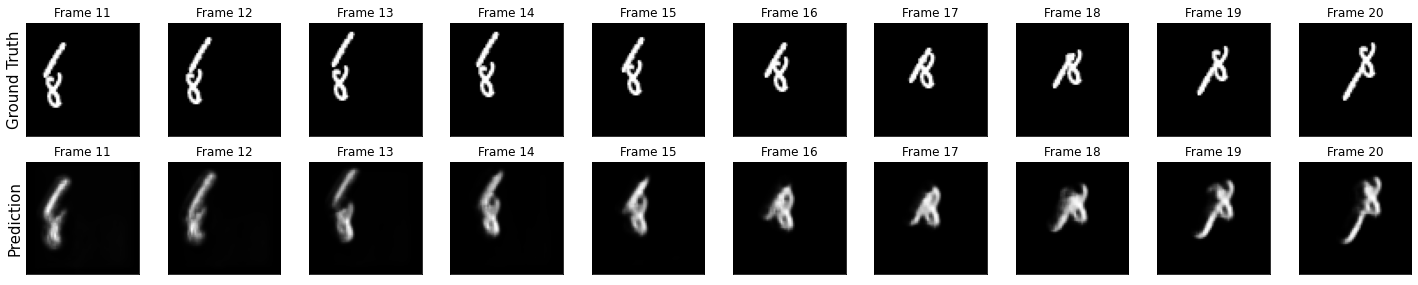
Training Dataset
This model was trained on the Moving MNIST dataset.
For next-frame prediction, our model will be using a previous frame, which we'll call f_n, to predict a new frame, called f_(n + 1). To allow the model to create these predictions, we'll need to process the data such that we have "shifted" inputs and outputs, where the input data is frame x_n, being used to predict frame y_(n + 1).

- Downloads last month
- 22